As illustrated in the following diagram, Backburner consists of the Backburner Manager, Backburner Monitor, and Backburner (slave) servers. These operate in the greater context of creative applications (such as, the Autodesk Creative Finishing applications), adapters/plug-ins, and rendering engines like Burn.
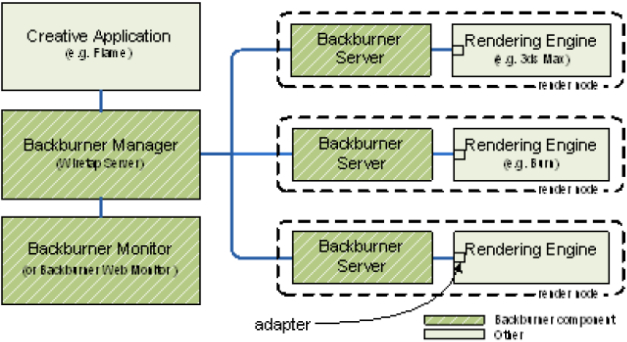
At the centre of Backburner is the Backburner Manager. It receives jobs from render clients, which it then distributes to the render nodes on the network. The Backburner Manager maintains status information about its network of Backburner (slave) servers. It also maintains a database of submitted, active, and completed jobs.
End-user interaction with the Backburner Manager, or jobs on the network is through the Backburner Monitor or Backburner Web Monitor. You can use these interfaces to monitor the progress of a job.
Generally, render nodes consist of a Backburner (slave) server, adapters/plug-ins, and rendering engines. The Backburner server performs the jobs assigned to it by the Backburner Manager. It does so by passing the jobs on to the rendering engine through the plugin/adapter. The adapter is furnished by the render client for the purpose of receiving instructions from the Backburner server and controlling the rendering engine.
The kinds of jobs a server can process depends on the adapter/plug-ins installed on it. Some Autodesk applications such as, 3ds Max have their own rendering engine. Others, such as, Creative Finishing applications share the Burn rendering engine and Wire® processing engine.