 This function smooths rough surfaces and rounds off sharp edges. It is available in the Mesh Edit menu or the context menu of the screen. When you start the function, a dialog box appears where you can choose how often you want to repeat the smoothing process (iterations) and where you can tick a box to choose, if you want to smooth all triangles of the part or only selected triangles. In the advanced mode you can determine the smoothing settings more precisely, which may result in longer calculation times.
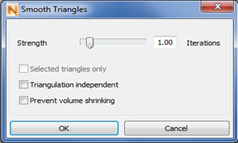
Figure 8.47: Define smoothing parameters
With every iteration, the following process takes place: For each corner point of the triangle mesh, the average position of the adjacent corner points is calculated. The position of the first corner point is then adjusted to this average value. That way, surfaces become smoother and corners and sharp edges of objects become rounder and are pulled inwards. The surface of the triangles is reduced by that process, as corner points are drawn more closely together. In the Basic mode it is important that your triangles have a similar size. That is why it is recommended to refine triangles before smoothing the triangle mesh. Otherwise, the result of the smoothing depends very much on the triangulation and less on the actual shape of the part.
In the advanced mode, you can set the smoothing strength using a slider in, which means that you are able to define the level of smoothing more individually. Then, there are three different options: Selected Triangles only: see above. Prevent volume shrinking: The part will be modified but the volume won’t get any smaller. Triangulation independent: As it’s being considered that the triangles have a different size, you hardly get any deformation effect and the shapes will be retained. This way, you don’t have to refine the triangle mesh before smoothing.
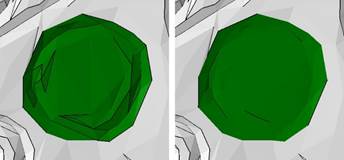
Left: Surface marked for smoothing, edges of more than 10° between normals visualized. Right: Smoothed triangles, no edges of more than 10° remain.
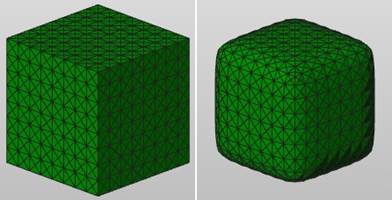
Smoothed Cube (five iterations).