After selecting Isotropic from the Type drop-down, the following material sections will be available to you: General, Structural, Allowables and Thermal.
-
General
-
Structural
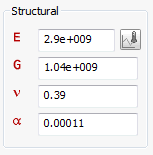
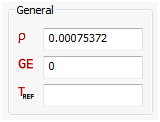
- You can input Young’s modulus, shear modulus, Poisson’s ratio, thermal expansion coefficient, mass density, material damping coefficient, and material reference temperature under the General and Structural sections.
- You also have the option to use a temperature dependence curve for Young’s modulus by clicking the
 icon.
icon. - Either E or G must be specified (i.e. nonblank).
- If any one of E, G, or NU is blank, it will be computed to satisfy the identity E = 2(1 + NU)G; otherwise, values supplied by you will be used.
- If E and NU or G and NU are both blank, they will both be given the value 0.0.
- Implausible data on one or more Isotropic material entries will result in a warning message. Implausible data is defined as any of E < 0.0, or G < 0.0, or NU > 0.5, or NU < 0.0, or |1 – E / [2(1+NU)G]| > 0.01.
- The mass density, RHO, will be used to automatically compute mass for all structural elements.
- To obtain the damping coefficient GE, multiply the critical damping ratio C/C0, by 2.0. If a dominate frequency is not defined for Material Structural Damping (see Dampings section), GE is ignored in transient response analyses.
- TREF and GE are ignored if the Isotropic material is referenced by a composite layup.
- TREF is used only as the reference temperature for the calculation of thermal loads in linear solutions. If an initial temperature load is specified, TREF will be ignored.
-
Allowables
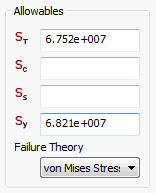
- You can input allowable values for tension, compression, and shear under Isotropic Allowables section.
- Factor of safety calculations are based on two methods: von Mises stress or principal stress. When Failure Theory is set to von Mises Stress, the factor of safety is calculated within the application using:

Whereas Nastran solver, in order to calculate STATUS results, is using:

And when Failure Theory is set to Principal Stress, the factor of safety is calculated using:
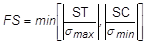
where ST and SC come from the input fields,
 is the von Mises stress, and
  and
and  are the maximum and minimum principal stresses.
-
Thermal
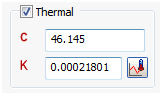
- For thermal analyses, you can input values for conductivity, specific heat, and mass density under the Thermal section. Mass density is repeated since it may be a requirement in thermal analysis as well as in structural analysis.
- Conductivity can be made temperature dependent by clicking the
 icon when a nonlinear heat transfer solution is selected.