Improvement in Section Definition
Now you can accept or prevent rotation of the coordinate system by 90 degrees (to have Iy > Iz). As a result, you can save sections in one not rotated coordinate system.
The local coordinate system of a cross section is specified as follows: the origin coincides with the center of gravity, while axes are rotated so that the moments of inertia with respect to these axes assume extreme values. Iy is usually considered maximal and Iz minimal. Sometimes, for example for symmetric sections, it may cause rotation of the local coordinate systems by 90 degrees. Such rotation of axes, where the Y axis is vertical and the Z axis is horizontal, is not always helpful. This improvement lets you keep the same position of the local axes, disregarding the relation between Iy and Iz. This way, you can keep the constant orientation of the local axes for the whole family of sections of different proportions.
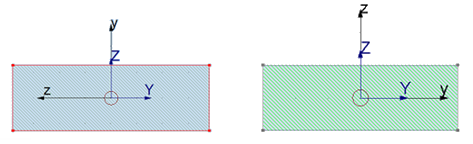
Position of the local coordinate system of a cross section