
Simulation-based STL files can be exported from completed part-scale thermo-mechanical simulations of powder bed builds. There are two primary uses for exporting STL files:
- Creating a compensated STL- a compensated STL, using a negative warp factor, inverts the simulated displacements and warps the reference STL geometry by those values, multiplied by the warp factor. Printing compensated STLs from an accurate simulation should result in reduced distortion, as the compensated STL should distort into the desired shape.
- Creating a warped STL - a warped STL, using a positive warp factor, applies the simulated displacements directly to the reference STL geometry by those values, multiplied by the warp factor. This creates an STL representation of the simulation results. This type of file can be used for model and material validation or to check to see if the distorted part fits within a part assembly.
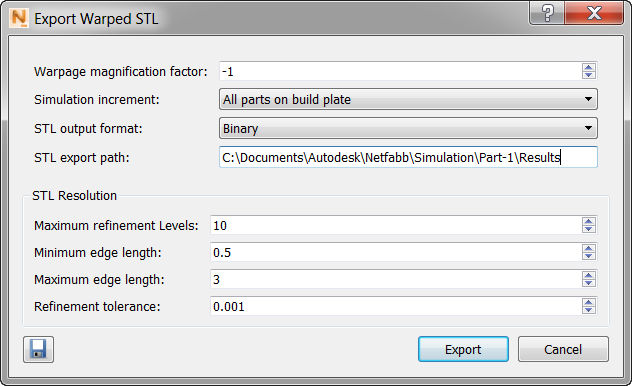
Warpage magnification factor
This specifies the value to multiply all simulated displacements applied to the reference geometry. Negative values are used to create compensated STLs and positive values are used to create distorted STLs.
- Compensation factors: Allowable values are between -0.01 and -4. Typical values fall between -0.5 and -1. A value of -1 would perfectly invert predicted distortion. Compensation factors should account for both the error of the model and the fact that the compensated model will not distort exactly as the original model did, due to the change in geometry.
- Distortion factors: Allowable values between 0.01 and 99. A value of 1 would produce an STL file with the same displacements predicted by the model, useful for assembly fit or validation. Greater or lesser values can be used to exaggerate or reduce the predicted distortion, for analysis of how the part develops distortion.
Simulation increment
Specify which simulation increment to produce the warped STL from, which may be:
- All parts on build plate
- After removal from build plate
- After removal from build plate and support structure removal
Warpage occurs after the part has been cooled to the final temperature and any optional heat treatment schedule.
The two latter options, after build plate removal, should only be enabled if in , Structural Plasticity has been set to On. Otherwise, the excessive distortion after build plate removal will create an overly warped or compensated STL file.
STL output format
Choose either the Binary format for a smaller file, or ASCII, which produces a human-readable file.
STL export path
Use the STL export path field to specify a destination directory for the warped STL.
Maximum refinement levels
Specify the maximum number of times an edge can be subdivided. Increasing this value will provide more accurate representation of the modeled distortion, but will result in slower file generation and a larger STL file. For large, complex geometries it is recommended to decrease this from the default value.
Minimum and maximum edge length
Specify the shortest and longest edges allowed in the exported STL, respectively. Decreasing either edge length will take longer to export and produce a larger STL file. Increasing the allowable edge lengths will produce a smaller STL file, but may result in a poorer representation of the model results.
Refinement tolerance
Set a value to indicate how accurately the warped STL must represent the actual simulation results. Lower tolerance values will produce more accurate results, but at the expense of larger files and slower generation times.
If you click the Export icon
 in the lower left, a file
<part_name>_tivus_warp#.in is generated to your project folder, with # replaced by the Warpage Magnification Factor. This file can be used to generate a warped STL from the command line. Consult the
Local Simulation help to learn how to use this file.
in the lower left, a file
<part_name>_tivus_warp#.in is generated to your project folder, with # replaced by the Warpage Magnification Factor. This file can be used to generate a warped STL from the command line. Consult the
Local Simulation help to learn how to use this file.
When you click the Export button in the lower right, three files are exported to the destination specified as the STL export path:
- <part_name>_warp#.in, the input file which is sent to the executable.
- <part_name>_warp#.out, a text file that records numeric values about the simulation.
- <part_name>_warp#.stl, the exported STL file.