A boundary node is any node that is connected to only one element.
When looking at figure 2, the computational domain of a typical circuit, it can be seen that nodes [C] and [F] are the boundary nodes for this circuit. Boundary conditions need to be specified on all the boundary nodes in the network. The more accurate boundary conditions, the more accurate the results.
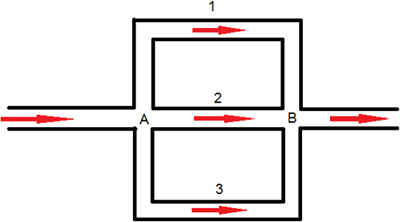
Figure 1. Parallel flow through a circuit
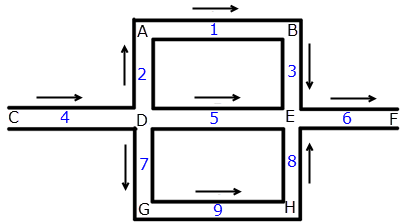
Figure 2. Computational domain of the circuit in figure 1.
When solving cooling circuits, at least one boundary condition in the network needs to be a pressure boundary condition. This is used to anchor the entire solution to a specific pressure.
- Pressure boundary condition
- A pressure boundary condition is the precise pressure of the fluid at the boundary node. If the cooling circuit is discharging fluid out to atmosphere, unrestricted, the typical pressure boundary condition would be atmospheric pressure or zero gauge pressure.
- Flow rate boundary condition
- A flow rate boundary condition can be specified as a volumetric flow rate, mass flow rate, velocity and Reynolds number. If the density is known at the boundary node of an incompressible fluid, the boundary condition can be represented as a volumetric flow rate. If the density is unknown the flow rate boundary condition can be represented as a mass flow rate.
- Thermal boundary condition
- The only thermal boundary condition required for the fluid is the coolant inlet temperature. The default for the Ei,j term is zero flux meaning that the fluid in the element has no interaction with its surroundings. The fluid is perfectly insulated for the default case. For the default case the temperatures stays constant throughout the network, except if two inlets in the network have different temperatures. Then only mixture effects are considered.
- Elevation
- For incompressible fluids, the density is very high and elevation differences have a significant impact on the flow solution. Due to the siphoning effect, the elevations are only important on the boundary nodes in the solution and are calculated from the spatial nodal coordinates for each node provided you enter the direction of the gravity vector.