For 3D compression molding analyses, the initial charge is represented by a of meshed block.
The initial charge mesh defines which nodes in the part mesh are already filled at the start of the analysis. Make sure the initial charge mesh is a realistic representation of the actual charge geometry; only initial charge elements that are inside the XY lateral extent of the part mesh are considered in the simulation.
For convenience, create the initial charge mesh offset in the compression direction relative to the part, to ensure that the part mesh and the charge mesh are not overlayed before the start of the analysis. At the start of the analysis, the solver automatically moves the initial charge mesh into the starting position above the part mesh.
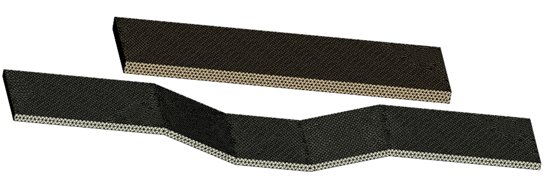
Initial charge (top) and Part (bottom) mesh
You can create a rigid, or a flexible, initial polymer charge. A rigid initial charge maintains it original shape at the start of the analysis, and then conforms to fill the cavity during compression. A flexible initial polymer charge drops and drapes the cavity space at the start of compression. The extent to which it conforms to the cavity shape at the start of compression depends on both the part geometry, and the mesh density of both the part and the initial charge. The greater the mesh density, the better the initial charge conforms to the cavity shape, but the longer the analysis takes.
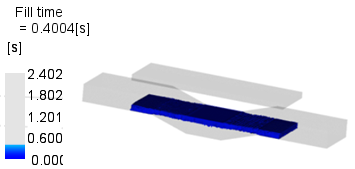
Rigid initial charge at the start of compression
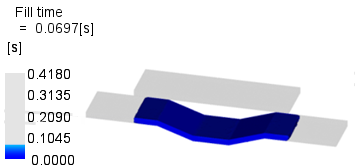
Flexible initial charge at the start of compression