|
Python API 2.0 Reference
|
|
Python API 2.0 Reference
|
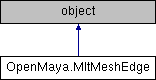
 Inheritance diagram for OpenMaya.MItMeshEdge:
Public Member Functions | |
| def | __init__ () |
| def | __iter__ () |
| def | __next__ () |
| def | center () |
| def | connectedToEdge () |
| def | connectedToFace () |
| def | count () |
| def | currentItem () |
| def | geomChanged () |
| def | getConnectedEdges () |
| def | getConnectedFaces () |
| def | index () |
| def | isDone () |
| def | iter () |
| def | iternext () |
| def | length () |
| def | next () |
| def | numConnectedEdges () |
| def | numConnectedFaces () |
| def | onBoundary () |
| def | point () |
| def | reset () |
| def | setIndex () |
| def | setPoint () |
| def | updateSurface () |
| def | vertexId () |
Static Public Member Functions | |
| def | __new__ () |
Properties | |
| isSmooth = property(...) | |
An iterator for traversing a mesh's edges.
| def OpenMaya.MItMeshEdge.__init__ | ( | ) |
Initialize self. See help(type(self)) for accurate signature.
| def OpenMaya.MItMeshEdge.__iter__ | ( | ) |
Implement iter(self).
|
static |
Create and return a new object. See help(type) for accurate signature.
| def OpenMaya.MItMeshEdge.__next__ | ( | ) |
Implement next(self).
| def OpenMaya.MItMeshEdge.center | ( | ) |
center(space=kObject) -> MPoint

Returns the center point of the edge, in the given transformation space.

* space (MSpace constant) - The  transformation space
| def OpenMaya.MItMeshEdge.connectedToEdge | ( | ) |
connectedToEdge(index) -> bool

Determines whether the given edge is connected to the current edge.

* index (int) - Index of edge to check.
| def OpenMaya.MItMeshEdge.connectedToFace | ( | ) |
connectedToFace(index) -> bool

Determines whether the given face contains the current edge.

* index (int) - Index of face to check.
| def OpenMaya.MItMeshEdge.count | ( | ) |
count() -> int

Return the number of edges in the iteration
| def OpenMaya.MItMeshEdge.currentItem | ( | ) |
currentItem() -> MObject

Returns the current edge in the iteration as a component.

Components are used to specify one or more edges and are useful in operating on groups of non-contiguous edges for a surface.
Components do not contain any information about the surface that they refer to so an MDagPath must be specified when dealing with components.
| def OpenMaya.MItMeshEdge.geomChanged | ( | ) |
geomChanged() -> self

Resets the geom pointer in the MItMeshEdge. If you're using MFnMesh to
update Normals or Color per vertex while iterating, you must call geomChanged
on the iterator immediately after the MFnMesh call to make sure that your
geometry is up to date. A crash may result if this method is not called.
A similar approach must be taken for updating upstream vertex tweaks
with an MPlug. After the update, call this method.
| def OpenMaya.MItMeshEdge.getConnectedEdges | ( | ) |
getConnectedEdges() -> MIntArray

Returns the indices of edges connected to the current edge.
| def OpenMaya.MItMeshEdge.getConnectedFaces | ( | ) |
getConnectedFaces() -> MIntArray

Returns the indices of the faces connected to the current edge.
Normally a boundary edge will only have one face connected to it and
an internal edge will have two, but if the mesh has manifold geometry
then the edge may have three or more faces connected to it.
| def OpenMaya.MItMeshEdge.index | ( | ) |
index() -> int

Returns the index of the current edge in the iteration.
| def OpenMaya.MItMeshEdge.isDone | ( | ) |
isDone() -> bool

Indicates if all of the edges have been traversed yet.
| def OpenMaya.MItMeshEdge.iter | ( | ) |
iter() -> self

Initializes the iterator object for pythonic iteration.
| def OpenMaya.MItMeshEdge.iternext | ( | ) |
iternext() -> self

Used in pythonic iteration to move the iterator
| def OpenMaya.MItMeshEdge.length | ( | ) |
length(space=kObject) -> float

Returns the length of the edge, in the given transformation space.

* space (MSpace constant) - The  transformation space
| def OpenMaya.MItMeshEdge.next | ( | ) |
next() -> self

Advances to the next edge in the iteration.
| def OpenMaya.MItMeshEdge.numConnectedEdges | ( | ) |
numConnectedEdges() -> int

Returns the number of edges connected to the current edge.
| def OpenMaya.MItMeshEdge.numConnectedFaces | ( | ) |
numConnectedFaces() -> int

Returns the number of faces connected to the current edge.
| def OpenMaya.MItMeshEdge.onBoundary | ( | ) |
onBoundary() -> bool

Determines if the current edge is a border edge.
| def OpenMaya.MItMeshEdge.point | ( | ) |
point(whichVertex, space=kObject) -> MPoint

Returns the position of one of the current edge's vertices, int the
given transformation space.

* whichVertex    (0 or 1) - Which of the edge's two vertices to return
* space (MSpace constant) - The transformation space
| def OpenMaya.MItMeshEdge.reset | ( | ) |
reset() -> self
reset(mesh) -> self
reset(mesh, component=None) -> self

Reset the iterator to the first edge of the mesh.

Reset the iterator to the first edge of the specified mesh

* mesh (MObject) - The polygon for the iteration

Reset the iterator with the given mesh and component.
If component is None then the iteration will be for all edges in the mesh.

* mesh (MDagPath) - The mesh to iterate over
* component (MObject) - The edges of the mesh to iterate over
| def OpenMaya.MItMeshEdge.setIndex | ( | ) |
setIndex(index) -> int

Sets the index of the current edge to be accessed. The current edge
will no longer be in sync with any previous iteration.

Returns the index of the edge which was current before the change.


* index (int) - The index of desired edge to access.
| def OpenMaya.MItMeshEdge.setPoint | ( | ) |
setPoint(point, whichVertex, space=kObject) -> self

Sets the position of one of the current edge's vertices, in the given
transformation space.

* point       (MPoint) - The new position for the specified vertex
* whichVertex (0 or 1) - Which of the edge's 2 vertices to set.
* space (MSpace constant) - The transformation space
| def OpenMaya.MItMeshEdge.updateSurface | ( | ) |
updateSurface() -> self

Tells Maya that mesh has been changed and needs to redraw itself.
| def OpenMaya.MItMeshEdge.vertexId | ( | ) |
vertexId(whichVertex) -> int

Returns the global index (as opposed to face-relative index) of one of
the edge's vertices.

* whichVertex (0 or 1) - Which of the edge's 2 vertices to use.
|
static |
True if the edge is smooth, False if it is hard.
 1.8.10