Use the Insert Elevation Point command to insert an elevation point on a feature line.
Specify a location, distance, or increments at which to insert multiple points. When a single point is inserted, you can specify the elevation.
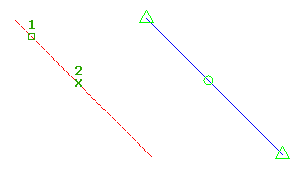
To insert a feature line elevation point by selecting a location
- Click
 Find.
Find.
- Select the feature line or other object.
- Click to select the location along the feature line to insert the elevation point.
- Specify the elevation by entering a value. Or enter Surface to obtain the elevation from a surface. If only one surface is in the drawing it is selected automatically.
- Select another point or specify a distance to insert another point.
To insert a feature line elevation point by specifying a distance
- Click
Find.
- Select the feature line or other object.
- Enter Distance.
- Select an existing point on the feature line to specify the start of the distance. If you select a point other than the start or end point, you must then select the direction.
- Enter a distance to define the location of the elevation point.
- Do one of the following to define the elevation of the point:
- Enter a grade.
- Enter Slope and enter a slope.
- Enter Elevation and enter an elevation. Or enter Surface to obtain the elevation from a surface.
- Enter Difference and enter an elevational difference.
To insert multiple elevation points at an increment
- Click
Find.
- Select the feature line or other object.
- Enter Increment.
- Enter a value to define the length of the increment. Points are placed equidistant along the feature line using the specified increment.
Note: Using this option, you are not prompted for elevations. The points are automatically assigned the elevation that exists at their location on the feature line.
How to activate OSNAP when adding an elevation point to a feature line
Civil 3D may automatically change
OSNAP settings when working with certain objects like feature lines. This can disrupt user preferences and cause workflow issues. You can, however, invoke OSNAP when needed in these situations. The following procedure details how to make an individual OSNAP call.
- When a command such as InsertElevPoint is active, hold Shift + right-click to open the contextual menu.
- From the menu, select your desired snap point.
The chosen snap applies only for the next point. Your default OSNAP settings will persist for future object snaps.