Data in the [MOUSE_WEIRS] group of the UND file is imported into the InfoWorks ICM Weir and User Control tables. This topic contains details on the conversion of MOUSE weir information to InfoWorks ICM.
Weirs Group - [MOUSE_WEIRS]
|
MOUSE |
Description |
InfoWorks ICM Data Field |
||||||||||||
|---|---|---|---|---|---|---|---|---|---|---|---|---|---|---|
|
WEIRID |
Weir name |
Asset ID |
||||||||||||
|
LOCATION |
NodeID where weir is placed |
US Node ID |
||||||||||||
|
FLOWTO |
NodeID where flow is diverted to If FLOWTO is not specified the weir discharges out of the system. |
DS Node ID If FLOWTO is not specified, an outfall node is created downstream of the weir, named <us node id>_out. |
||||||||||||
|
CRESTLEVEL |
Crest Level |
Crest Level (Weir) Initial Level (User Control) (See METHODNO below) |
||||||||||||
|
METHODNO |
Weir Method:
|
If the method specified is Q-H, the weir is exported as a User Control of type Compnd. A Head Discharge Table named using the weir primary key is also created.
If the method specified is Weir Formula the weir is exported as a Weir or VCWeir, depending on whether RTC is set. |
||||||||||||
|
DATASETID |
Used when Method is Q-H. Dataset ID in the Tabular Data Section describing the QH relationship. |
A Head Discharge Table is created named using the weir primary key. The head array and discharge array in the Head Discharge Table are imported from the TABULAR DATA section. |
||||||||||||
|
CRESTTYPENO |
Crest Type (Weir Formula method only):
CRESTTYPENO specified has no effect on calculations as both are treated as Sharp Crested by MOUSE. |
Weirs imported as standard weirs. |
||||||||||||
|
CRESTWIDTH |
Crest Width (Weir Formula method only). |
Crest Width |
||||||||||||
|
WEIRFLOWANGLE |
Used when Method is Weir Formula. Used to calculate the discharge coefficient if there is no user specified coefficient. Either 0° or 90°. |
Used to calculate Coefficient of Discharge. See Calculation of Coefficient of Dischargenote below |
||||||||||||
|
WEIRCOEFFICIENT |
Headloss coefficient. Overrides the in-built weir coefficient calculation. |
Used to calculate Coefficient of Discharge. See Calculation of Coefficient of Dischargenote below |
||||||||||||
|
CONTROLTYPENO |
Type of Weir Control (Weir Formula method only):
|
Exported to Link Type as follows:
|
||||||||||||
|
MAXSPEEDUP |
Used for RTC weirs only. Maximum speed at which crest rises. |
Positive speed (Not directly equivalent, as InfoWorks ICM Positive Speed is speed, not maximum speed.) |
||||||||||||
|
MAXSPEEDDWN |
Used for RTC weirs only. Maximum speed at which crest falls. |
Negative speed (Not directly equivalent, as InfoWorks ICM Negative Speed is speed, not maximum speed.) |
||||||||||||
|
MAXLEVEL |
Used for RTC weirs only. Maximum crest level of weir |
Maximum Value |
||||||||||||
|
MINLEVEL |
Used for RTC weirs only. Minimum crest level of weir |
Minimum Value |
Calculation of Coefficient of Discharge for Weirs
MOUSE weirs are imported into InfoWorks ICM as standard weirs.
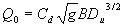
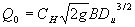
The InfoWorks ICM standard weir equation is as follows:
|
|
Where: Q0 = free outfall discharge, m3/s Cd = discharge coefficient g = acceleration due to gravity, m/s2 B = width of weir, m Du = upstream depth with respect to the crest, m |
MOUSE Weir Equation (Discharge Coefficient Not Supplied)
MOUSE weir equation when a discharge coefficient is not supplied:
|
|
|
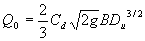
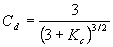
The discharge coefficient, Cd, is calculated from the outlet headloss coefficient:
|
|
If the weir is at 0° to the flow:
If the weir is at 90° to the flow:
Where: Kc = outlet headloss coefficient obtained from location node |
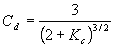
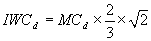
The discharge coefficient is converted to an InfoWorks ICM discharge coefficient by applying the following formula:
|
|
Where: IWCd = InfoWorks ICM discharge coefficient MCd = MOUSE discharge coefficient |
MOUSE Weir Equation (Discharge Coefficient Supplied)
The MOUSE weir equation when a discharge coefficient is supplied is as follows:
|
|
Where: CH = user-specified level discharge coefficient MCd = MOUSE discharge coefficient |
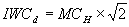
The MOUSE relative weir coefficient, MCH, will be converted to the InfoWorks ICM discharge coefficient, IWCd, by:
|
|
|