View and Navigate Files on Mobile
You can view 2D and 3D files that have been downloaded to your mobile device.
In this topic, you'll learn how to:
Open Files on Mobile
To view files synced to your Autodesk Forma mobile app:
Tap Files
 on the bottom of the screen.
 Select either root folders to access your desired subfolders and files.
- For the Field folder: Members with view permissions can access and download files
- Project Files folder: Members can only view, download and interact with folders and files as defined by the folder permissions granted to them on web.
Tap on an individual file to open it.
Generally, a file needs to be downloaded before you can view it. See Sync and Download Files for more information on downloading files.
View and Navigate 2D Files
These are the various ways that you can view and navigate 2D files:
Use hand gestures to navigate:
- Pinch or spread with two fingers to zoom in or out.
- When zoomed in, swipe in any direction to look around across the document.
- Swipe up or down when viewing a full page to navigate through multi-page documents.
Add markups using the markup toolbar and interact with issues. Learn more
Tap the magnifying glass icon
 to search for text within the document.
 Tap the filter icon
 to streamline your view, such as hiding markups and only viewing the issue pins.
View and Navigate 3D Models
These are the various ways that you can view and navigate a 3D model:
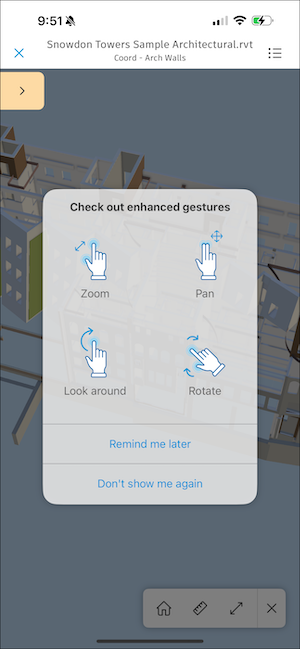
Enhanced hand gestures: Zoom, Pan, Look around and Rotate
- Zoom: Pinch or spread with two fingers to zoom in or out.
- Pan: Drag two fingers in any direction of the model.
- Look around: Hold one finger on a specific location and move in any direction.
- Rotate: Rotate two fingers around a point.
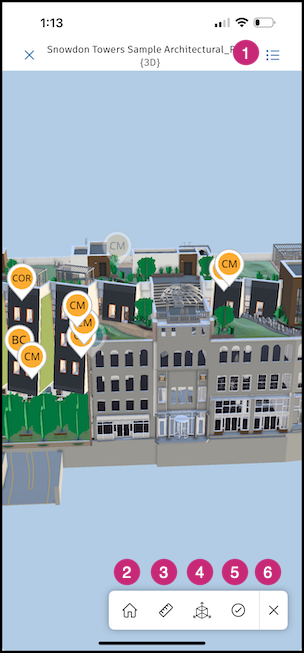
Tools: The following numbers correspond to the numbers in this screenshot.
Menu: Tap
 to access the following:
Views: View any 2D or 3D views associated with your model
Viewpoints: View any existing viewpoints in your model
Note: Saved Model Browser filters are not applied to viewpoints in the viewer. So viewpoints may not appear as they appear on web if there are hidden objects.Issues: View and edit issues
Model Browser: Browse all model objects
Levels: See a list of levels in the model
Assets: View and edit assets
Settings
Change units of measurement
Change the selection mode: Leaf Object, First Object, Last Object
Review the hand gestures
Turn on or off the new viewer
Send BETA feedback
- Details: View file information
Home view: This resets the model to the original view.
Issues: Create issues on the model. Learn more about creating issues on mobile.
Sectioning:
- Tap a surface to start sectioning the model.
- Hold and drag the arrow that appears on the respective surface to section the model at the desired location.
- Tap the icon again to exit sectioning mode.
Measurement: Tap the ruler icon
 and select a measurement tool. See Measure 3D Models on Mobile.
Tap
 to collapse the toolbar.
Viewing options: Tap on any object in the model to receive further viewing options. The following numbers correspond to the numbers in this screenshot.
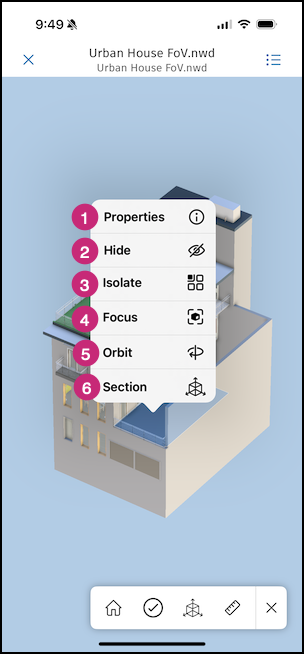
- Properties: View the selected object's properties.
- Hide: This will hide the selected object. Tap to show.
- Isolate: View only the selected item. All other unselected model components will disappear. Tap to return to the full model.
- Focus: Tap to bring the selected object into the centre of your view.
- Orbit: Tap to free orbit around the model. In orbit mode, the camera moves around the focal point of the model.
- Section: Provides a single face to cut the model along the X, Y or Z planes. Tap an object on any plane and use the manipulator to cut the model along that plane. Tap to return to the full model.
Mark-ups and issues
2D views: View, create and edit markups and issues. Learn more about the markups toolbar and creating issues on mobile.
3D views: View, create and edit issues. Tap
in the top-right corner to find the Issues list. Note: Issues can't be moved in 3D views.
Navigate 3D Models in First Person
In the new viewer, you can walk through a 3D model in first person using on-screen joysticks, similar to a game controller. This drone-style mode keeps you at a fixed elevation so you can look around freely as you move without accidentally changing height.
Turn the Joysticks On or Off
When the joysticks are visible, you're in first-person navigation. When they're hidden, you're in the standard orbit and free-look mode.
To return to orbit mode, toggle the joysticks off. Your on or off choice is remembered for the rest of your app session, including if you leave the viewer and come back.
Move with the Left Joystick
The left joystick controls movement on the horizontal plane:
- Up: Walk forward.
- Down: Walk backward.
- Left: Sidestep left without changing the direction you're facing (strafe).
- Right: Sidestep right without changing the direction you're facing (strafe).
You can hold the joystick in any direction across a full 360° range. The further you push it, the faster you move.
Look Around with the Right Joystick
The right joystick rotates the camera, like turning your head:
- Up: Tilt the view up toward the ceiling.
- Down: Tilt the view down towards the floor.
- Left: Turn over your left shoulder.
- Right: Turn over your right shoulder.
You can rotate fully around the horizontal axis (360°). Vertical tilt is clamped at straight up and straight down (180° total).
Change Level
Use the dedicated up and down buttons to move vertically. Level changes use your current movement speed setting.
Jump to a Location
Double-tap any surface in the model to fly to that point quickly.
Walk Through Walls and Doors
Double-tap any vertical surface to temporarily hide that object and move to the other side.
Adjust Movement Speed
A speed control near the joysticks lets you change how fast you move and change level, so you can navigate models of different sizes comfortably. The base speed is calculated automatically from the extents of your model.
| Setting | Multiplier of auto-calculated base speed |
|---|---|
| Slow | 0.5× |
| Normal | 1.0× |
| Fast | 2.0× |
| Turbo | 4.0× |
Invert the Y-Axis
By default, dragging the right joystick up tilts the view up. If you prefer flight-sim style controls, turn on Invert Y-Axis in the viewer settings. Dragging up then tilts the view down, and dragging down tilts it up.
Use the Minimap
When you enter first-person mode, a minimap appears showing a plan view of your surroundings at your current level. The minimap helps you stay oriented as you move through the model.
The minimap shows:
- Your position in the model.
- The direction you're facing, shown relative to project north.
- The current level you're on.
As you move, the minimap pans to keep you centred. The minimap rotates to match the direction your camera is facing on the horizontal plane.
To show or hide the minimap, use the minimap setting in the viewer. Your choice is remembered across sessions.