Design Code Updates
Code checking to 'AASHTO LRFD Bridge Design Specifications 10th Edition' and 'Australian Standards AS 5100:2017 Amendment 2' has been added.
AASHTO LRFD Bridge Design 10th Edition
Code checking to American 'AASHTO LRFD Bridge Design Specifications 10th Edition' has been added.
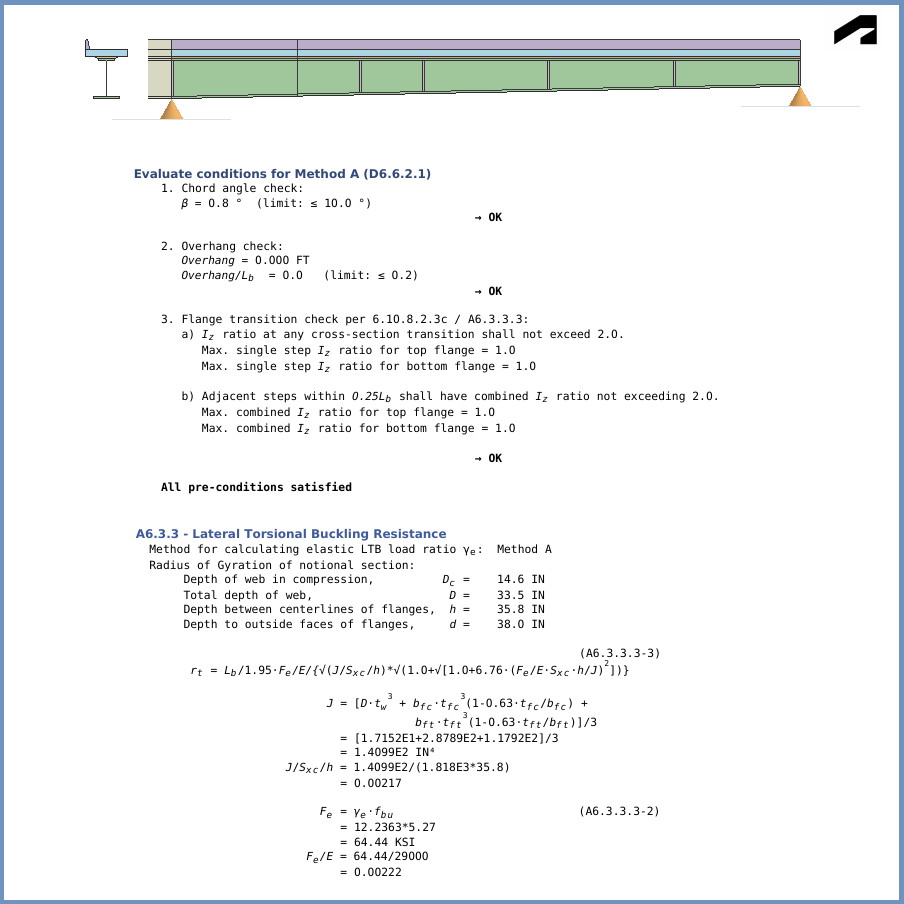
The 10th edition introduces new, refined computations for steel structure member lateral torsional buckling (LTB) calculations specifically for nonprismatic unbraced lengths. To calculate the elastic LTB load ratio, both Method A and Method B of Article D6.6 have been implemented.
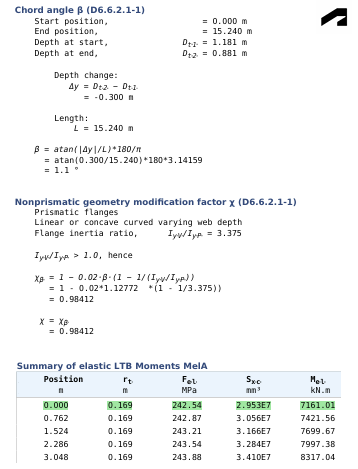
Other significant revisions include the replacement of the moment-gradient modifier, Cb equation, and revisions to shear stud design.
Earlier implemented editions (7th and 9th) have been retained to allow for conversion between editions.
AS 5100:2017 Bridge Design Amendment 2

Code checking to Australian Standards 'AS 5100:2017 (Second Edition) Amd 2' has been added. This amendment updates the following parts:
Part 2: Design Loads — The amendment revises clauses and tables affecting the design loads for road, rail, and pedestrian bridges.
Part 5: Concrete — The amendment incorporates revisions to concrete design provisions, including updates to shear and torsion, and creep and shrinkage parameters. For pre-tensioned beams, ultimate positive and negative design moments are now considered separately.
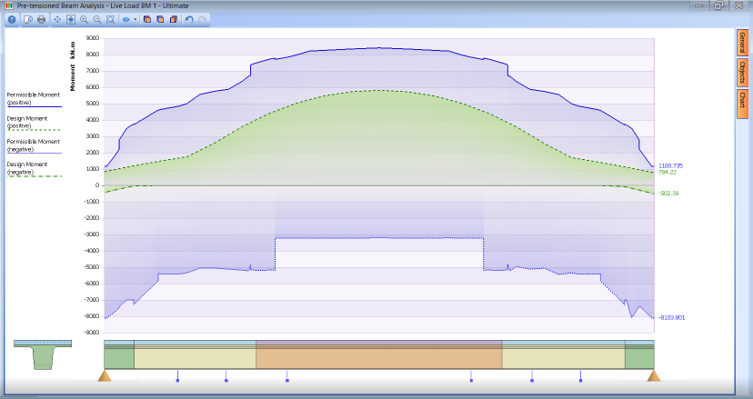
The changes formally address a number of corrections that were previously available as an unofficial errors and omissions option introduced in 2022.1. That option has been superseded by this amendment.
Miscellaneous
Torsion 'Treat as box' parameter
A 'Treat as box' design section analysis torsion parameter has been added for Australian Standards AS 5100:2017 (Clause 8.2.1.2) and US AASHTO LRFD 9th Edition and later (Article 5.7.2). When checked, the design section is treated as a box section for the consideration of torsion effects.
Eurocodes crack width calculations
For design sections, post-tensioned and reinforced concrete beams:
- Clause 7.3.4 nominal cover override is now available for all national implementations (previously limited to UK and Ireland variations).
- A new checkbox to ignore concrete tensile strength has been added.
Post-tensioned beam duct modification factor
The lambda duct modification factor per AASHTO LRFD 10th Edition Article A5.7.3.3 has been implemented. For post-tensioned beams, the shear link contribution due to shear strength will be reduced in the presence of post-tensioning ducts in the web.