Smoothing reference
Smoothing serves to compress the toolpath size, improve part quality, and make CNC machines run more smoothly.
Many machining strategies produce primary cutting toolpaths made up mainly of linear moves. When enabled, Smoothing attempts to replace those linear moves with arcs (G2/G3 moves) within a given tolerance. Most 2D and 3D milling strategies support smoothing. Fusion fits arcs in all planes that make sense for the selected strategy. The post processor linearizes arcs that the control does not support.
The Smoothing setting is located on the Passes tab of standard 2D and 3D milling toolpath dialogs.Smoothing is off by default.
Toolpath examples
The images below show toolpaths with and without smoothing for parallel and contour strategies. Black dots mark the end points of linear and arc moves.
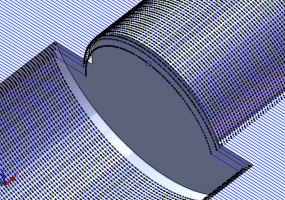
Parallel toolpath without smoothing
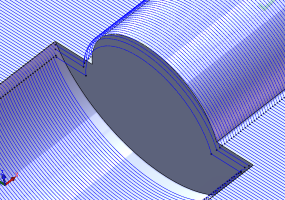
Parallel toolpath with smoothing applied
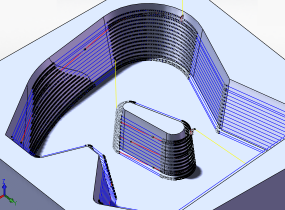
Contour toolpath without smoothing
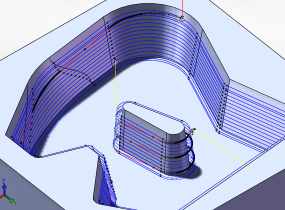
Contour toolpath with smoothing applied