Most results in the Report Manager for Multiple Fireflow Analyses are the same as those for standard simulations. However, unlike regular extended time runs, these simulations assign additional required fire demand values to selected fire junctions during the defined fire event.
An additional Multiple Fireflow report summarizes loading and residual pressure conditions for the operated hydrants. This report is available immediately after the simulation completes.
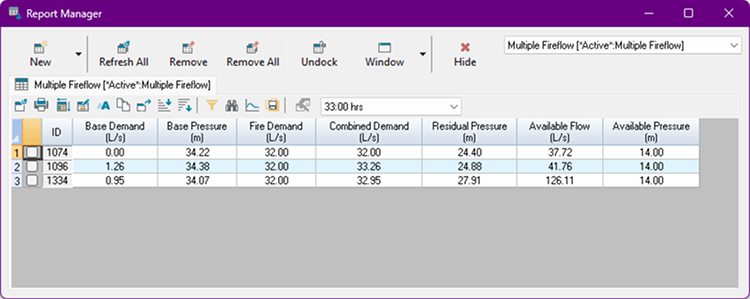
If the fire event isn't instantaneous and spans multiple hydraulic time steps, use the time drop-down menu above the table to select the step for displaying results.
ID - Identifier of the fire junction.
Base Demand - Or "static" demand, is a regular demand without any fire flow added. Doesn't include leakage or emitter flows.
Base Pressure - Or "static" pressure, is pressure at the junction when the whole system is loaded with base/static demands.
Fire Demand - The required fire demand defined by the user.
Combined Demand - The sum of the Base Demand and Fire Demand. Doesn't include leakage or emitter flows.
Residual Pressure - Pressure at the junction when the whole system is loaded with Combined Demand values.
Available Flow - The maximum flow that can be extracted from the fire junction, simultaneously with flows at other fire junctions, without violating defined pressure and velocity constraints. These values include base/static demands (i.e., fire capacity plus static capacity). Note that these values assume the system was previously loaded with static and required fireflow demands, not available flow values.
Available Pressure - Pressure at the junction when all fire junctions are loaded with available flows.