About change management
In Fusion Manage, change management, workflows, and lifecycles work together to control how items are modified, reviewed, and released.
Items are created and maintained in revision-controlled workspaces, while changes to those items are managed through revisioning workspaces. Workflows in revisioning workspaces open and close change windows, control approvals, and move items through their lifecycle phases. This structure ensures that every change is tracked, reviewed, and released in a controlled way.
Revision-controlled workspaces
Revision-controlled workspaces enforce strict control over how items are modified and released. In these workspaces:
- Items can be edited only when they are unreleased or when a specific "change window" is open.
- Approved changes are saved as a new revision.
- When a new revision is created, the previous revision is permanently locked and can't be modified.
Each revision represents a phase in that item's development.
Lifecycle phases
As items are revised, they move through lifecycle phases. As an administrator, you can customize these phases, but most items follow a structure similar to the following:
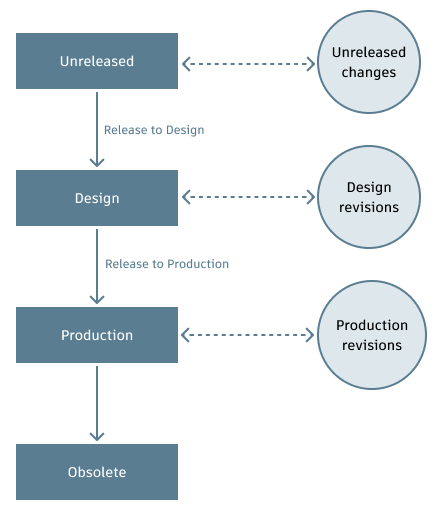
- Unreleased: A newly created item in a revision-controlled workspace. Anyone with edit rights can modify it. Unreleased items typically represent the initial specification or definition of a product or item.
- Design (or Working): The item is under development. Each design iteration produces a new revision number.
- Production: The item is released and approved for production or manufacturing.
- Obsolete: The item has reached its end of life and is no longer produced.
The diagram below shows how lifecycle transitions and revisions work together. Items begin as Unreleased, move to Design and Production through release actions, and may undergo multiple revisions within each phase. Once an item is no longer needed, it is transitioned to Obsolete, where no further revisions occur.
Revisioning workspaces and change windows
Revising items and moving them through their lifecycle is managed in a revisioning workspace. A revisioning workspace works alongside revision-controlled workspaces to support your product lifecycle management process. It typically contains the documentation, approvals, and workflow steps required to revise or release one or more items.
Items from revision-controlled workspaces are linked to revisioning items using the Managed Items tab. See Managed Items. When a revision-controlled item is linked to a revisioning item:
A change window opens, allowing linked items to be modified and moved through the defined workflow stages (e.g., Design, Approval, Implementation).
A green stamp appears on the item's working version, indicating that it is currently being managed by an item in a revisioning workspace.

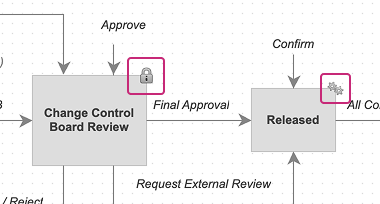
A revisioning workspace has a workflow defined with a specific state called the "managed" state, which is indicated by a managed icon  on the workflow map. When a revisioning item reaches the managed state, all linked items move to their next lifecycle phase and the change window closes. Each linked or affected item advances to a new revision, and the previous revisions are locked. The updated revisions then become the active versions used going forward.
Optionally, if a "lock" state is configured before the managed state, the change window closes when the item reaches that lock state instead. Locked states are indicated by a lock icon  on the workflow map.
Asynchronous item release
By default, all linked or affected items are released at the same time when the revisioning item reaches the managed state.
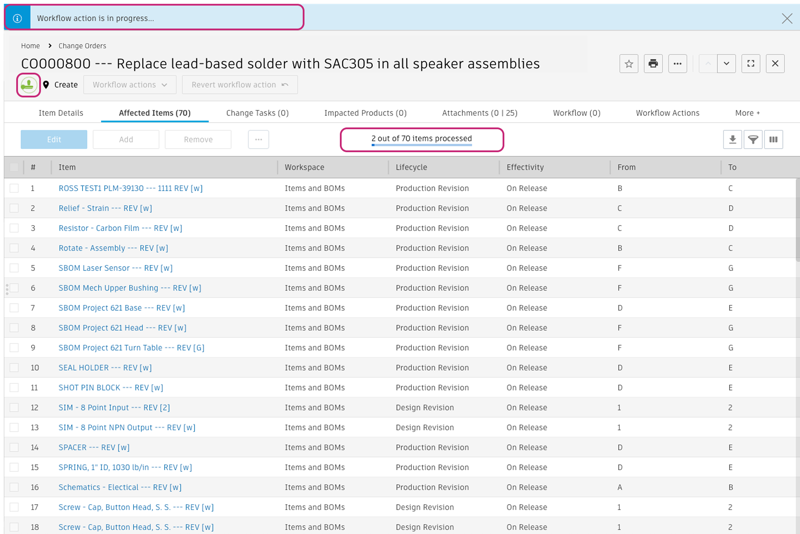
Administrators can change this behavior by enabling Asynchronous item release in General Settings. When enabled, items are released one at a time in the background, which can improve speed and performance when releasing many items at once.
With asynchronous release:
- Release progress is tracked in real time.
- The workflow action completes automatically once all items are successfully released.
- If any affected items fail to release, you can retry the workflow action to complete the process.
Revisions, working versions, superseded items, and BOMs
Items in a revision-controlled workspace can be changed only when the item is unreleased, or a change window is opened via a revisioning workspace.
In both cases, changes are made to what is called the item's "working version".
Working versions and unreleased items
Unreleased items have only one version, the working version. In the item selection list, these items appear with an asterisk. In the BOM, these items are identified by a lowercase w to show they are an unreleased working version.
When an unreleased item is released through a Change Management workspace, its working version is hidden and can't be modified until a new change window is opened.
Revising released items
When a new change window is opened for a released item, its working version becomes available for modification.
When the item is revised through a Change Management workspace:
- A new revision is created.
- The previous revision is marked as superseded and can no longer be changed.
Once the revisioning item reaches the managed state, all BOMs automatically update their references to point to the new version.