Usage
In Tandem
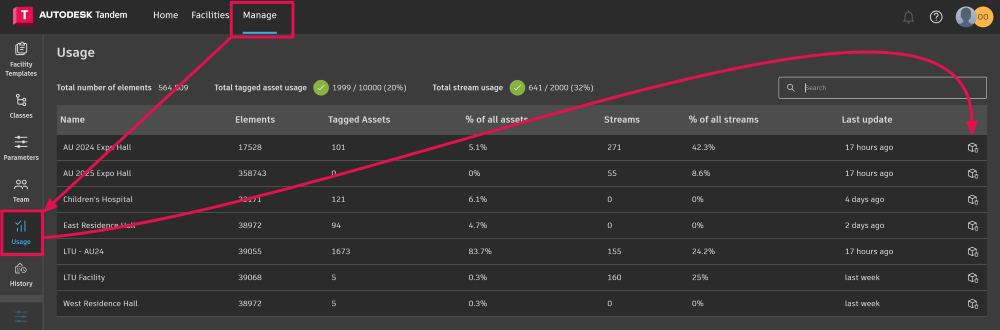
With Account Administrator permissions, you can review the overall total of Assets and stream usage across your portfolio in addition to the assets and streams for each facility. To view account usage navigate to the MANAGE page within Autodesk Tandem then to the Usage tab.
For each facility within a portfolio the Administrator can also view:
- Total number of elements with a facility
- Total number of Assets
- Percentage of assets within a facility compared to total of all assets
- Total number of streams
- Percent of streams within a facility compared to the total of all streams
- Number of reserved Data Points
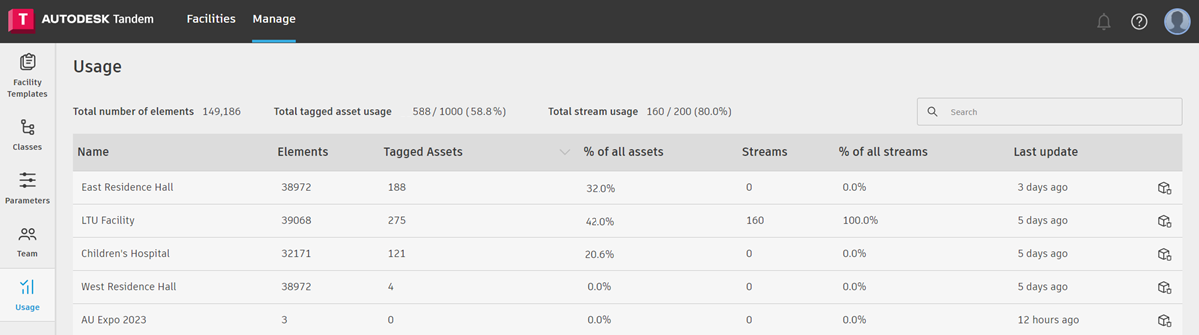 Usage in a Tandem Legacy account
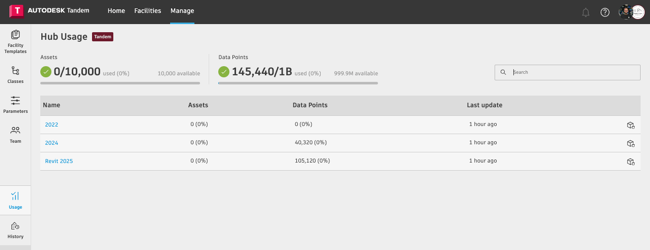 Usage in a Capacity Tandem account
In Autodesk Account
Primary Admins can also check usage for their Tandem accounts by logging into Autodesk Account and then navigating to Reporting → Resource and API Usage.
Here you'll see cards for Tandem - Assets and Tandem - Data Points.
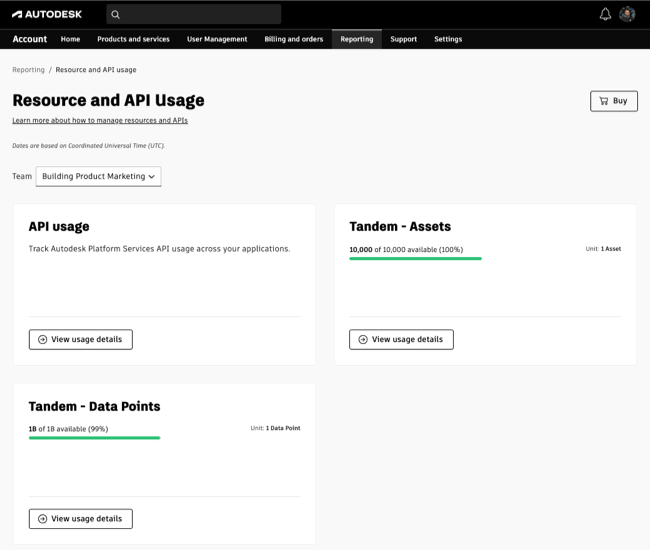
You click View usage details to see more granualr detail.
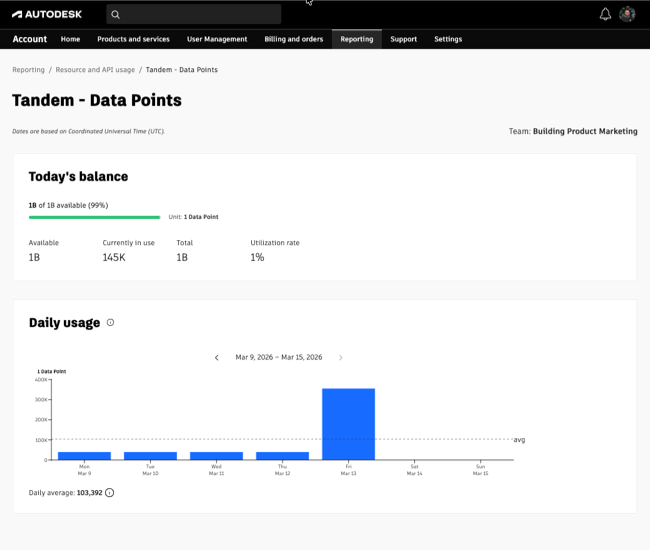
What is an Asset?
An Asset is an asset that has been classified, and users have clicked Make Asset (pictured below).
You may want to make an element into an asset when you decide to, for example:
- Add or manage additional descriptive information (metadata) in Tandem
- Link documents (manuals, warranties, certificates)
- Track relationships to other assets or connect the element to live or historical data
An Asset can also be any Space, System, or Connection.
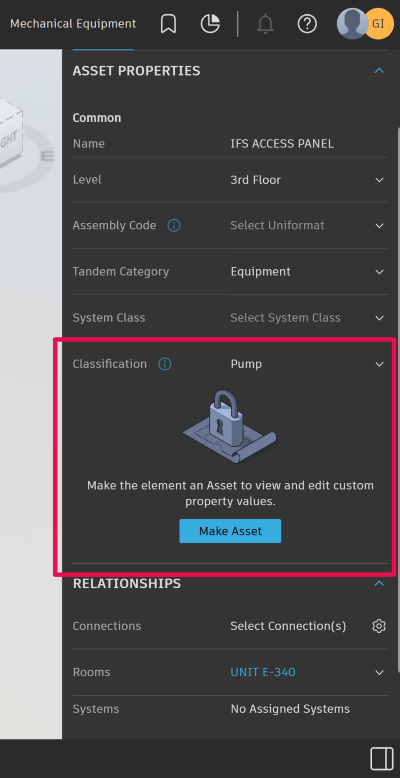
When all parameter data is cleared from an asset, thus untagging it, or a parameter is removed from an element, the data is not immediately deleted from those assets in the database to prevent mistaken deletion, or you need to recall it at a later point. So those elements may still be counted as assets in the database.
For an expanded explanation of the above review our Key Concepts page, or our Properties Panel page.
What is a Data Point?
A Data Point is a single measurement taken from a sensor or system.
Examples:
- Temperature reading
- Power consumption value
- Spindle speed
- Vibration level
Every time a sensor reports a value, that counts as one data point.
How are data points calculated?
Data points are collected into Streams. When you set up a stream, as part of a Connection in Tandem, you choose:
- How often data is collected (frequency)
- How long the data is stored (retention period)
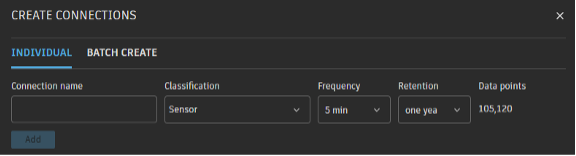
The total number of data points per stream depends on those two choices. A single device or connection can produce multiple data streams.
For example, an indoor air quality sensor may measure:
- Temperature
- Humidity
- CO₂
Although these measurements come from one physical device or Connection, they are treated as three separate data streams. Currently, all streams for a given connection share the same frequency configuration.
Data points are calculated per stream when the connection is configured, and the total data point volume is the sum of all streams.
Data points = how often you collect data × how long you’ve been recording it (in Days)
Example
You have a sensor reading Indoor Temperature that is measured every 5 minutes and you want to retain those readings for a year.
- 12 readings per hour
- 24 hours per day
- 365 days of retained data
Calculation:
12 × 24 × 365 = 105,120 data points
You'll see those data points added to the facility on the usage page immediately after you finish configuring the connection.
If the same device also measures humidity and CO₂ then total data points for that device would be:
3 streams × 105,120 = 315,360 data points
Facility Cleanup
Overview
The Facility Cleanup utility, is located under the Usage tab of the Manage page.
Purpose
When all parameter data is cleared from an asset, thus untagging it, a parameter is removed from an element, or a connection is deleted, the data is not immediately deleted from those assets or data points in the database to prevent mistaken deletion, or if you need to recall it at a later point. So those assets and data points may still be counted in the database.
Running Facility Cleanup ensures the asset and data point counts accurately reflect the current state of your facility.
Facility Cleanup removes parameter and data point information from elements that:
- Were previously classified and counted as an asset, but are no longer classified.
- Had classifications removed at the facility or template level.
- Contain orphaned parameter data that is no longer valid.
- Had their connection(s) deleted
How to Run Facility Cleanup
Follow these steps to clean up your facility and update your Asset counts:
- Clear parameter data: Remove all custom parameter data from elements you intend to un-tag. This ensures the parameter data will be completely removed from the database.
- Remove the classification: Clear the classification from each element.
- Remove any unwanted connections
- Run Facility Cleanup: Navigate to the Usage page → Manage tab → Facility Cleanup.
- This process removes old parameter data as well as all of the historical data points then updates the Asset and data point counts.
Example Scenarios
Example 1: Removing a Classification A user classifies an element and adds parameter data. Later, they remove the classification.
While the parameter data no longer appears in Tandem, it remains stored in the database, and is still counted in the Usage page. Running Facility Cleanup deletes this hidden data and updates the usage count.
Example 2: Deleting a Model
If you delete assets in Revit and reimport the model, those assets may still be counted as Assets in Tandem. To remove them entirely:
- Delete the model file from Tandem.
- Reimport the updated Revit file.
- Run Facility Cleanup to finalize the cleanup.
Pro-Tips
- Run Facility Cleanup after major classification or parameter updates.
- Regular cleanup ensures accurate billing and complete, trustworthy asset data.
Summary
The Facility Cleanup tool is meant to be utilized in maintaining a clean, accurate, and up-to-date asset and data point record in Autodesk Tandem.
By understanding how Assets and data points are counted and regularly running a cleanup, you ensure that your facility data, dashboards, and billing all accurately reflect the true state of your digital twin.