Long after AutoCAD was originally created, the concept of ModelSpace and PaperSpace was introduced to allow a more natural way to deal with 2D views of 3D models. This concept allow entities to exist in only one space; in a single document (DWG file), there is a single ModelSpace, and any number of PaperSpaces, each of which has an independent collection of entities. Entities in the paperspaces are not visible in modelspace. Entities in modelspace can be shown in paperspace by the use of viewports, which are "windows" into model space that can be placed in a paperspace. In this way, a single AutoCAD DWG file can contain a 3D model and any number of drawing "layouts" which represent actual 2D sheets.
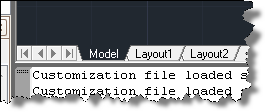
In the default AutoCAD setup, the different spaces are available via tabs at the bottom of the graphics window:
Intent supports these concepts with Designs and Mixins. However, because AutoCAD has no concept of an Assembly, Intent has used its Assembly hierarchy to allow the rule developer to create entities in the proper spaces and take advantage of the hierarchy that exists.
Layouts are rectangular regions that correspond to a sheet of paper, and in fact the standard Intent implementation of a layout is the DrawingSheet Design, which has parameters for standard paper sizes. Within this rectangular area, rectangular viewports are placed. A viewport is like a window into modelspace; it takes a view and some scaling factors, and allows the viewport to contain any view of modelspace that is desired. A view is just a collection of viewing parameters, such as the eye point, the target point, an "up" vector to determine the vertical orientation of the view, and several other parameters, such as the projection type. The view is "clipped" to the viewport boundary; nothing in the view will appear outside the viewport border.
By using consistent scaling and target points, it is possible to set up standard 3-view layouts that properly align with each other. Annotations, such as dimensions, are typically created as children of the layout, and use the viewport scaling and point mapping support to provide true modelspace dimensions.
- For a discussion about how the standard Intent rendering process is customized for Layouts, see Layouts, Updates and the Render Pipeline
- For a discussion about how to populate the tabs area with Intent-controlled layouts, see Controlling Layout Tabs with AllLayouts
- For a discussion about how to hide entities in some views, see Controlling Part Visibility in Layouts