Data Exchange with Alembic

Artists can now use the Alembic open computer graphics interchange framework format in 3ds Max. Alembic distills complex animated and simulated data into a non-procedural, application-independent set of baked geometric results. Designed to provide highly efficient use of memory and disk space, Alembic enables artists to view massive datasets in the Nitrous Viewport, and transfer them more easily between other teams and certain programs. A new playback caching system has been added since Extension 1, leading to significantly improved viewport performance.
Easier Revit and SketchUp Workflows
Users can now directly import and file link Revit RVT files into 3ds Max using a new, tighter Revit integration, first introduced in 3ds Max 2015 Extension 2. Artists can bring Revit models into 3ds Max up to 10x faster than before, and the new integration provides enhanced features such as improved instancing, additional BIM data, and multiple cameras. In addition, artists using SketchUp can now take their design further in 3ds Max by importing their SketchUp 2015 files.
Easier SolidWorks Import
The SolidWorks® application no longer needs to be installed or running on your system for you to import SolidWorks files.
ATF Importing
Autodesk Translation Framework (ATF) simplifies data exchange of both Autodesk and 3rd-party file formats, including SolidWorks®.
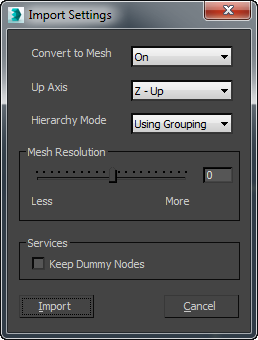
Inventor Animation Import
Autodesk Inventor Constraint and Joint Drive animation now imports to 3ds Max as baked keyframes. You can now create high-quality mechanical design animation and view it in 3ds Max without having to use 3ds Max IK and rigging features.