$ pan -t 11
After the above command is executed, a directory named 11 is created containing all files required to run the example.
Problem description
An Inconel 625 spherical geometry with support structures is built in a powder bed system using generic processing parameters. Both the part and support structure geometries are imported in the analysis through STL files and both are automatically meshed within Project Pan . The buildplate is modeled to be 10.88 mm thick using *DDM!. The time to deposit layers is calculated using the *PBDL card, here modeling the case where 5 identical geometries are built at once. The bottom of the build plate is fixed using the *FSUB card. The *FSUB card will also simulate the release of the buildplate from the machine after the deposition process is complete, but before the part is removed from the buildplate. The mesh, shown with and without the support elements, is shown in Figures 11.1.
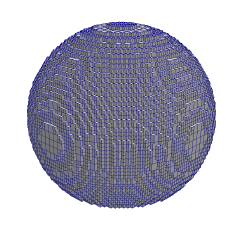
Figure 11.1 (a) Sphere without supports
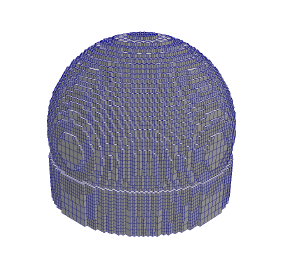
(b) Sphere with supports
A time incremental thermal analysis is performed first to compute the temperature history of the part. Layers are activated in groups using *PBPA, and additional time increments are used to model heat conduction into the part. The thermal analysis includes only the part and substrate. Heat loss into the powder is modeled as convection with a value of 25.d-6 W/((mm2)-degC) using *CONV.
A time incremental mechanical analysis is performed after the thermal analysis is completed. Similarly to the thermal analysis, layers are activated in groups and the computed temperature distribution from the mechanical analysis is used to compute deformation due to the thermal expansion. These simulations have three additional post-process simulation increments, first Local Simulation simulates the release of the buildplate from the machine, then the removal of the build from the buildplate, and finally the removal of the support structure material from the final build.