
Click to manage the materials in the library.Users can create new materials, delete unwanted ones, and copy a material to use as a basis for defining a new one.
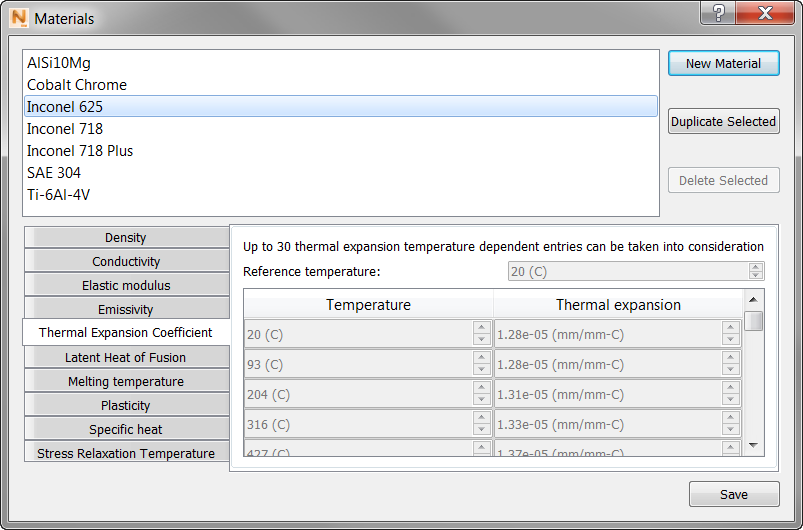
When creating a new material, first specify the name, and then the various physical properties in the chosen system of units. To change the system of units shown here, go to the Simulation menu

 Settings General tab, and open the Units drop-down menu.
There are some minimum requirements for material properties, depending on how the material is used. For build plates, the minimum requirements are Thermal Conductivity, Density, Specific Heat, Coefficient of Thermal Expansion, Elastic Modulus, and Plasticity properties. These properties, along with Thermal Emissivity, Latent Heat of Fusion, and Melting Temperature are required for generating accurate processing parameter (PRM) files. Stress Relaxation Temperature should be included for materials such as Ti-6Al-4V which exhibit a significant sub-melting temperature reduction of stresses. If available, using as built properties will produce more accurate simulation results.
Best Practices
- Density - The model uses a uniform density. Temperature dependent density effects may be accounted for in the thermal model by adjust the temperature dependent specific heat properties.
- Thermal Conductivity - Thermal conductivity should be provided to the highest possible temperature, preferably close to the melting temperature.
- Elastic Modulus and Poission's Ratio - These values should be provided to the highest possible temperature. For metals without a known a known Poission's Ratio, a generic value 0.3 may be used.
- Thermal Emissivity - Temperature dependent emissivity will produce more accurate model results, but may slow model convergence. Averaging temperature dependent emissivities into a single value is an accepted practice.
- Thermal Expansion Coefficient - This property has the largest impact upon the accuracy of the mechanical model and should be included up to the highest possible temperature, preferably close to the melting temperature.
- Latent Heat of Fusion - Excessive values for Latent Heat of Fusion may cause poor convergence. If the thermal model fails to converge check that this value is in the correct units and range, typically between 250-400 J/g.
- Melting temperature - Setting this value too low or high may negatively impact the accuracy of the predicted distortion results.
- Plasticity - Up to 5 pairs of stress-strain points may be used to describe the plasticity curve of the material at each temperature. Perfect plasticity is assumed after the final plasticity point at each temperature. Every temperature must use the same number of points. To enter in the plasticity curve specify the temperature, stress, and strain. Points with the same temperature will describe the yielding behavior at that temperature. For example using 3 points to describe the yielding behavior of a metal would look like this:
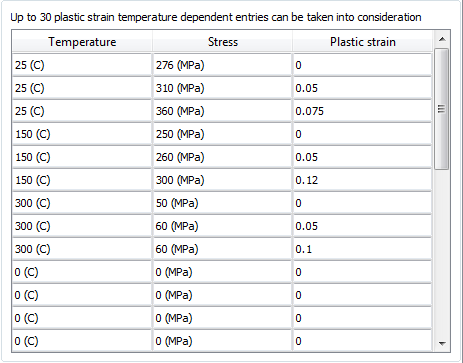
Different approaches for approximating the plasticity curve are shown in the figure below: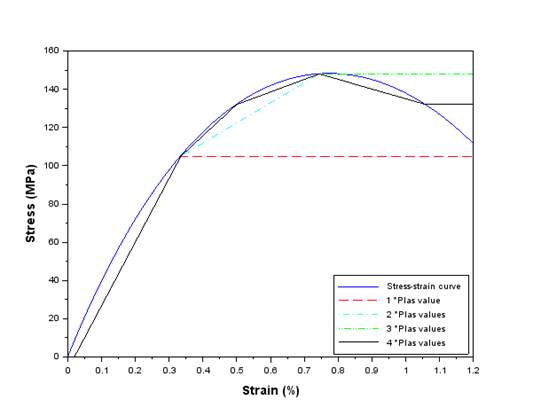
Using more points allows for a closer approximation of real material behavior, but may increased the computational time during moving source simulations, PRM generation, and models which enable Structural Plasticity. - Specific heat - Specific heat should be provided to the highest possible temperature, preferably close to the melting temperature
- Stress Relaxation Temperature - Should only be included for materials known to have significant sub-melting stress relaxation behavior.