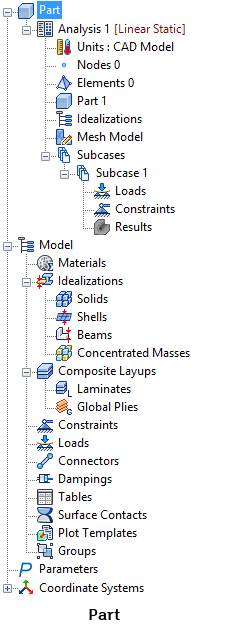
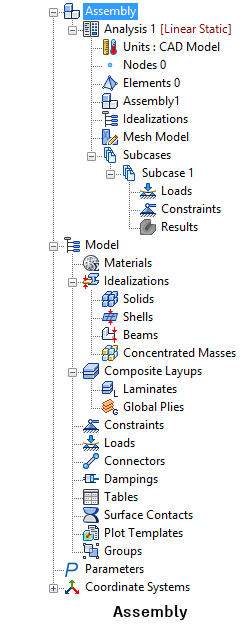
The Analysis tree item contains a collection of sub-level tree items as shown in the following figures:
Right-click on Analysis. The following options are available:
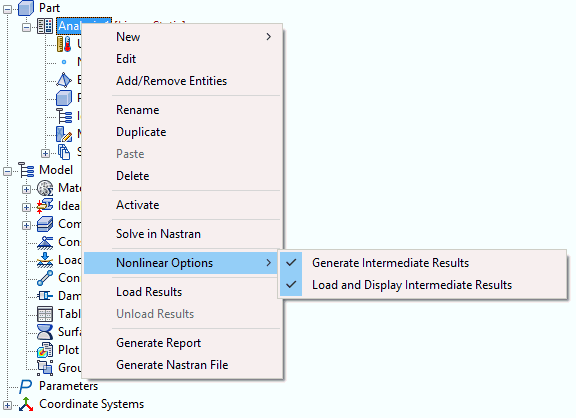
- New:
- Subcase
- Material Orientation
- Edit
- Add/Remove Entities
- Rename (Change the name of the analysis)
- Duplicate
- Paste
- Delete (Delete analysis)
- Activate
- Solve in Nastran
- Nonlinear Options:
- Generate Intermediate Results: When this option is checked, the solver generates .FNO files for each increment that can be loaded while the analysis is running. When the analysis is completed, these intermediate .FNO files are compiled into one.
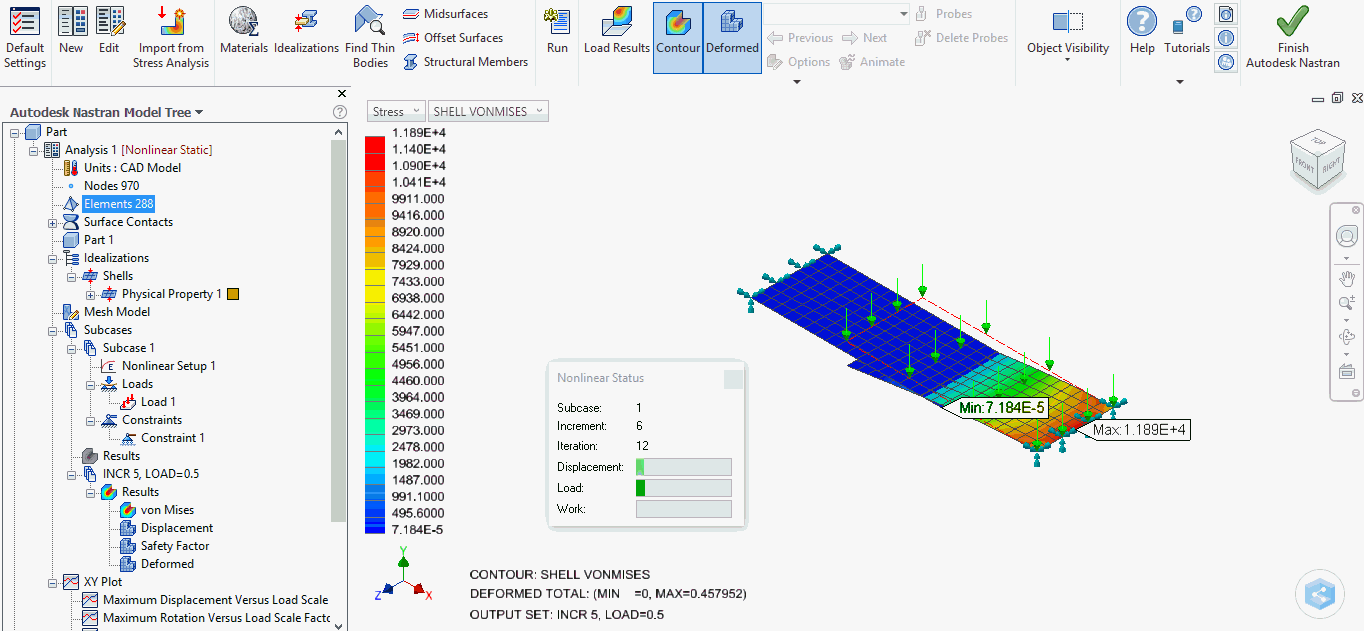
- Load and Display Intermediate Results: This option works in conjunction with Generate Intermediate Results and thus, is only available when that option is checked. The incremental results are automatically loaded into the tree under Subcases and can be viewed until the next increment has been solved. This is shown in the example below.
- Load Results
- Unload Results
- Generate Report
- Generate Nastran File
The sub-level tree entities under Analysis are:
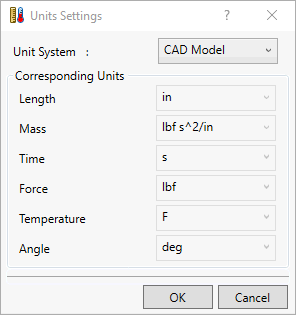
- Units: Provides an option to define a unit system directly at
Analysis level.
- Nodes (Displays total number of Nodes in the mesh)
- Elements (Displays total number of Elements in the mesh)
- Connectors
- Surface Contacts (For assemblies only)
- Part/Assembly (For assemblies the individual parts are listed under the assembly name)
- Idealizations:
- Solids
- Shells
- Beams
- Mesh Model
- Mesh Control
-
Subcases
- Loads (Provides an option to define loads directly at subcase level)
- Constraints (Provides an option to define constraints directly at subcase level)
- Results (Default plot templates gets loaded under it directly once the solution is successful)
 Analyses can be dragged and dropped onto a part or assembly name to make a copy of the analysis. The copy is activated automatically.
You can select the generation of partial results for modal and transient analysis types to decrease the size of the results file and to decrease the calculation time required for solution.