USD for Maya 0.37 adds diagnostic tools to help you manage asset paths. See all paths in your scenes, including tokens, environment variables, and file paths, to find issues before they affect your work.
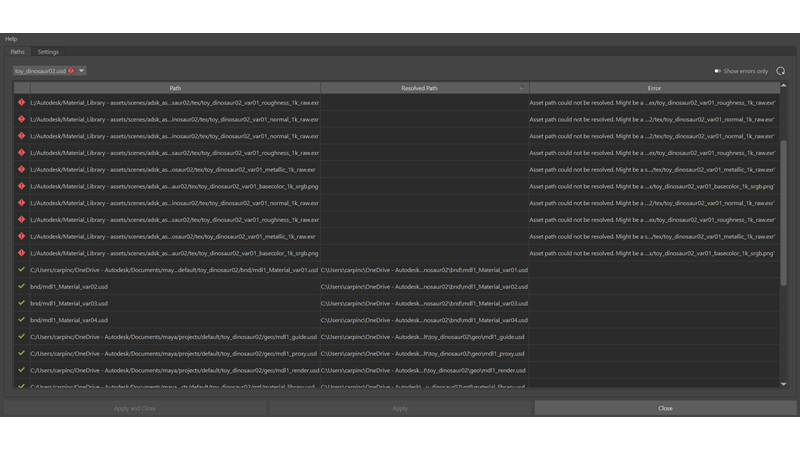
The new Path Editor shows all paths within your stage in one view. Search through tokens, file paths, environment variables, and other resolvable references quickly. Unresolved paths are clearly marked so you can spot problems immediately. Switch between stages from a dropdown menu while staying focused on your task. This saves time diagnosing path issues and helps ensure your scenes are configured correctly.
Path Management
- Preview path changes before applying
- Before you apply modifications in the Path Editor, a preview shows how many paths will be affected. This helps you verify changes and avoid unintended side effects to your scene.
- Identify stages with unresolved paths
- Error icons now appear in the stage dropdown for any stage containing unresolved paths. This visual indicator helps you quickly spot and prioritize scenes that need attention.
- View active regex path mappings
- Asset Resolver Settings now display regex mappings organized by priority. Each mapping shows its expression and value pair, with a lock icon indicating they are managed externally. This helps you understand active path substitutions when working with references and sublayers.
- Manage tokens and project settings
- A new Tokens view in Asset Resolver Settings displays all available tokens grouped by type, showing their names and values. You can enable or disable project tokens using a toggle to control which tokens are active during asset resolution.
- Review path mapping configuration
- Asset Resolver Settings now display all path mappings organized by priority. Each mapping shows its name and value, with a lock icon indicating external management. This gives you clarity about which path substitutions are active during resolution.
Component Building
- Create components from USD prims
- Build components directly from selected USD data in the Outliner. Right-click and choose to create components with or without variants, with configurable options. This streamlines the process of organizing and managing component hierarchies.
- Assign Purpose values to USD data
- Set Purpose values on USD data from the variant editor. Purpose scopes are created automatically when needed. This helps you organize data by render purpose (guide, proxy, render) without manual layer management.
- See current variant edit target
- When editing variants in Component Builder, a path now displays which variant you are targeting. This prevents confusion when working with complex component hierarchies and ensures your edits go to the right variant.
Layer Management
- View Edit Forwarding status
- A banner in the Layer Editor now shows when Edit Forwarding rules are active. This makes it clear how your edits are being routed, reducing confusion about where changes land in your layer stack.
- Debug Edit Forwarding in Script Editor
- Enable "Echo Edit Forwarding in Script Editor" from the Layer Editor options to track all Edit Forwarding operations. This helps you understand and troubleshoot edit routing behavior in complex scenes.
- Merge and organize layers
- Merge sublayers into their parent or root layer, or combine multiple same-strength layers together. Right-click context menus make this easy. Reduces clutter and improves layer organization in complex compositions.
- Automate Edit Forwarding with Python
- Use the new AdskUsdEditForward Python module to programmatically define Edit Forwarding rules. Advanced users can now automate where USD edits land in the layer stack, enabling custom workflows and integration with pipelines.
Rendering
- Use default USD render settings
- Loading the Maya USD plugin now creates a default USD Render Settings node in the Outliner. This gives you a simple way to render a USD stage with Hydra Storm or Hydra Arnold when the Hydra plugin is loaded.