Vulkan Improvements
VRED 2027 introduces Vulkan multi‑GPU support for XR, enabling VR HMD setups to render left and right eye views on separate graphics cards. This capability also extends to Left/Right and Top/Bottom split stereo rendering modes. You’ll also find auxiliary node rendering improvements for more consistent visualization in Display Cluster setups, along with additional enhancements.
Vulkan Multi GPU Support
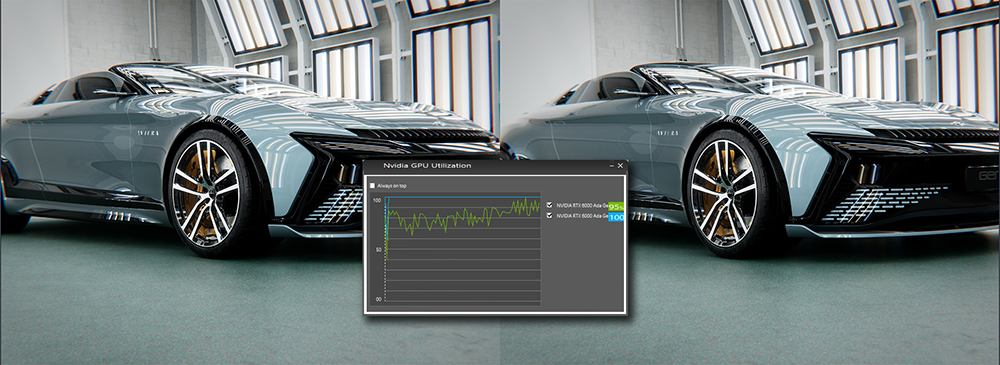
Vulkan now supports multi-GPU configurations for XR and stereo render modes, enabling VR HMD setups to render left and right eye views on separate graphics cards. Multi-GPU support can improve frame-rate up to 75% when compared to a single GPU. This capability also applies to Left/Right and Top/Bottom split stereo rendering modes.
 For more information on Vulkan Multi-GPU support, see Vulkan Multi-GPU.
Auxiliary Nodes
Grid, Ruler, Bounding Boxes, Cameras, Lights, Volumes, Joints, and Physics Colliders are now rendered using Vulkan, ensuring consistent visualization across Display Cluster setups. This change delivers modest performance and stability improvements by removing extra synchronization, data copying, and driver overhead between Vulkan and OpenGL. In addition, auxiliary nodes now behave consistently with GPU ray tracing, and all auxiliary visualizations are excluded from tone mapping and post‑processing.