Smart pointers allowing custom user classes (opaque classes) to be used within Amino graphs. More...
#include <Ptr.h>
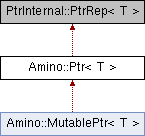
Public Types | |
| using | element_type = T |
| The type of objects referenced by the Ptr pointer. More... | |
| using | element_const_reference_type = typename std::add_lvalue_reference< const element_type >::type |
| A reference to a const element_type. More... | |
| using | use_count_type = std::intptr_t |
| The integral type of the use count. More... | |
Public Member Functions | |||
| Ptr (PtrDefaultFlag) | |||
| Construct a Ptr with a default value pointee. More... | |||
| template<class Y , class > | |||
| Ptr< T > & | operator= (Ptr< Y > const &rhs) noexcept | ||
| template<class Y , class > | |||
| Ptr< T > & | operator= (Ptr< Y > &&rhs) noexcept | ||
| template<class Y , class > | |||
| Ptr< T > & | operator= (MutablePtr< Y > rhs) noexcept | ||
Empty constructors | |||
| constexpr | Ptr () noexcept | ||
| Construct an empty pointer. More... | |||
| constexpr | Ptr (std::nullptr_t) noexcept | ||
| Construct an empty pointer. More... | |||
Constructors | |||
| template<class Y , class = if_compliant_and_convertible_from<Y>> | |||
| Ptr (Y *p) | |||
Construct a pointer that owns the object pointed by p. More... | |||
| template<class Y , class D , class = if_compliant_and_convertible_from<Y>> | |||
| Ptr (Y *p, D d) | |||
Construct a pointer that owns the object pointed by p. More... | |||
Templated null constructors | |||
| template<class D > | |||
| Ptr (std::nullptr_t, D d) | |||
| Construct a pointer to a null object with a specific deleter. More... | |||
Copy constructors | |||
| Ptr (Ptr const &rhs) noexcept | |||
| Copy constructor. More... | |||
| template<class Y , class = if_convertible_from<Y>> | |||
| Ptr (Ptr< Y > const &rhs) noexcept | |||
| Conversion constructor. More... | |||
Move constructors | |||
| Ptr (Ptr &&rhs) noexcept | |||
| Move constructor. More... | |||
| template<class Y , class = if_convertible_from<Y>> | |||
| Ptr (Ptr< Y > &&rhs) noexcept | |||
| Move conversion. More... | |||
| template<class Y , class = if_convertible_from<Y>> | |||
| Ptr (MutablePtr< Y > rhs) noexcept | |||
| Conversion constructor from a MutablePtr. More... | |||
Destructor | |||
| ~Ptr () | |||
| Destructor. More... | |||
Assignment operators | |||
| Ptr & | operator= (Ptr const &rhs) noexcept | ||
| Assignment operator. More... | |||
| template<class Y , class = if_convertible_from<Y>> | |||
| Ptr & | operator= (Ptr< Y > const &rhs) noexcept | ||
| Assignment conversion. More... | |||
Move assignment operators | |||
| Ptr & | operator= (Ptr &&rhs) noexcept | ||
| Move assignment operator. More... | |||
| template<class Y , class = if_convertible_from<Y>> | |||
| Ptr & | operator= (Ptr< Y > &&rhs) noexcept | ||
| Move assignment conversion. More... | |||
| template<class Y , class = if_convertible_from<Y>> | |||
| Ptr & | operator= (MutablePtr< Y > rhs) noexcept | ||
| Move assignment conversion from a MutablePtr. More... | |||
Modifiers | |||
| void | swap (Ptr &rhs) noexcept | ||
| Swap two pointers. More... | |||
| void | reset () noexcept | ||
| Reset the pointer to an empty pointer. More... | |||
| template<class Y , class = if_compliant_and_convertible_from<Y>> | |||
| void | reset (Y *p) | ||
| Reset the content of the Ptr to now manage the given pointer. More... | |||
| template<class Y , class D , class = if_compliant_and_convertible_from<Y>> | |||
| void | reset (Y *p, D d) | ||
| Reset the content of the Ptr to now manage the given pointer. More... | |||
| MutablePtr< element_type > | toMutable () noexcept | ||
| Conversion to MutablePtr. More... | |||
Special modifier | |||
Short-hand to allow modifying the pointee held by this Ptr when its ownership is known to be unique (use_count() == 1). This can be useful in some scenario, but in general it is recommended to use a guard (see Amino::PtrGuard and Amino::createPtrGuard) to mutate the pointee.
Amino::Ptr<T> ptr = createMyPtr();
// We know it's unique because it was just created.
assert(ptr.unique());
// Therefore it's safe to mutate.
ptr.mutate([](T* ptee) {
ptee.modify();
});
Smart pointers allowing custom user classes (opaque classes) to be used within Amino graphs. Definition: Ptr.h:207 bool unique() const noexcept Returns whether the object is uniquely owned by the pointer. Definition: Ptr.h:1297 | |||
| template<typename Func > | |||
| void | mutate (Func &&func) | ||
Accessors | |||
| element_const_reference_type | operator* () const noexcept | ||
| Indirection. More... | |||
| element_type const * | operator-> () const noexcept | ||
| Indirection. More... | |||
| element_type const * | get () const noexcept | ||
| Accessor. More... | |||
| bool | unique () const noexcept | ||
| Returns whether the object is uniquely owned by the pointer. More... | |||
| use_count_type | use_count () const noexcept | ||
| Returns the use count of the pointed object. More... | |||
| operator bool () const noexcept | |||
| Returns whether the pointer is non-null. More... | |||
| template<class Y > | |||
| bool | owner_before (Ptr< Y > const &rhs) const noexcept | ||
| Owner-based ordering of Ptr. More... | |||
Friends | |
| template<class Y > | |
| class | Ptr |
| Friendship to allow conversion between pointers of different types. More... | |
| template<class Y > | |
| class | PtrGuard |
| Friendship to allow access to getPointee, getCtrlBlck, and init. Used when the guard is created with the Amino::PtrGuardUniqueFlag. More... | |
Detailed Description
class Amino::Ptr< T >
Smart pointers allowing custom user classes (opaque classes) to be used within Amino graphs.
- Warning
- Amino::Ptr is NOT replacements for standard smart pointers (like std::shared_ptr). It is only meant to be used within Amino graphs. Therefore, if a value never needs to flow directly into the graph, a standard smart pointer (like std::shared_ptr) should be used instead.
This class is a smart pointer used to manage the life-scope of the pointee objects and help implementing persistent data structures, respecting value semantics.
In general, in Amino, a Ptr pointer would be referring to objects of following types:
The Ptr class stores a pointer to a dynamically allocated object. The object is typically allocated using the C++ new operator. An optional customizable deleter can be specified in case the object hasn't been allocated with the C++ new operator.
Ptr references are implemented using reference counting, and the pointed object is automatically released when no remaining Ptr is referencing it.
Because the pointee of a Ptr is always const, and the compiler checks for constness, there is no possibility of cyclic references between objects.
Copying a Ptr creates a new reference to the same object. This operation is thread-safe. Ptr can thus be safely passed to other threads.
Accesses to the pointed object are not synchronized between threads. Other means of protection must be used to insure the thread-safety of the pointed object. This is unnecessary for immutable objects as these are trivially thread-safe.
The pointed object of Ptr is always const. This allows embedding of Ptr in other const objects (structs, lists, arrays), giving a immutable overall data structure as a result.
- Warning
- In that respect, Amino::Ptr is different than std::shared_ptr. Amino::Ptr since access to the pointee is always const, unlike std::shared_ptr. This allows Amino::Ptr to be safely used to implement Persistent Data Structures. See Amino::Ptr::toMutable() for details.
The Ptr class meets the CopyConstructible, MoveConstructible, CopyAssignable and MoveAssignable requirements of the C++ Standard Library. Thus, Ptr objects can be stored in standard library containers. Comparison operators and a hash functor are supplied so that Ptr works with the standard library's associative containers.
- Precondition
- The dynamically allocated pointee class T must satisfy some criterion to be allowed to be stored in a Ptr. In particular, it must be copy constructible, because this is required to allocate a copy, when calling Amino::Ptr::toMutable(). The complete list of requirements on the pointee type T can be found in Amino::PointeeTraits.
- Warning
- The type T may not be the actual type of the dynamically allocated object, since the Ptr could have been downcasted (Ptr<BaseClass>) or type erased (Ptr<void>).
- Note
- If a function returns an Amino::Ptr then it is up to calling code to keep it alive while the calling code accesses the pointee.
- Warning
- It is recommended to avoid type-erasure (Ptr<void>) as much a possible. Static casting Ptr from/to void to type can lead to very subtle bugs, since potential "casters" must "agree" on the exact type T to use when casting to void or casting to T. Otherwise, this could lead to pointer misalignments (for example for classes with multiple inheritance), which would in turn lead to undefined behavior.
- Template Parameters
-
T The type of objects referenced by the Ptr pointer.
Member Typedef Documentation
◆ element_const_reference_type
| using Amino::Ptr< T >::element_const_reference_type = typename std::add_lvalue_reference<const element_type>::type |
◆ element_type
| using Amino::Ptr< T >::element_type = T |
◆ use_count_type
| using Amino::Ptr< T >::use_count_type = std::intptr_t |
Constructor & Destructor Documentation
◆ Ptr() [1/11]
|
inlineconstexprnoexcept |
Construct an empty pointer.
- Postcondition
get() == nullptr-
use_count() == 0
◆ Ptr() [2/11]
|
inlineconstexprnoexcept |
Construct an empty pointer.
- Postcondition
get() == nullptr-
use_count() == 0
◆ Ptr() [3/11]
|
inlineexplicit |
Construct a Ptr with a default value pointee.
- See also
- PtrDefaultFlag
◆ Ptr() [4/11]
Construct a pointer that owns the object pointed by p.
The object will be deleted using the expression Amino::PointeeManager::checkedDelete(p). As such, must be of a complete type. The pointer p used for deletion is captured at construction time of the Ptr.
The constructor is only considered if a Y* can be implicitly converted to a T*.
- Postcondition
get() == p-
use_count() == 1
- Parameters
-
[in] p a pointer to an object allocated via a C++ new expression or a null pointer.
◆ Ptr() [5/11]
Construct a pointer that owns the object pointed by p.
The pointer deleter is set to d. The object will be destructed using the expression d(p). The deleter is invoked in all cases even when the pointer is null. The pointer p used for deletion is captured at construction time of the Ptr.
The constructor is only considered if a Y* can be implicitly converted to a T*.
- Postcondition
get() == p-
use_count() == 1
- Parameters
-
[in] p a pointer to an object to be owned by the pointer or a null pointer. [in] d the deleter to invoke when the object is not longer referenced by any Ptr.
◆ Ptr() [6/11]
Construct a pointer to a null object with a specific deleter.
The pointer deleter is set to d. The null object will be destructed using the expression d(nullptr) when it is no longer referenced.
- Postcondition
get() == nullptr-
use_count() == 1
- Parameters
-
[in] d the deleter to invoke when the object is not longer referenced by any Ptr.
◆ Ptr() [7/11]
|
inlinenoexcept |
◆ Ptr() [8/11]
|
inlinenoexcept |
Conversion constructor.
If rhs is empty, constructs an empty Ptr; otherwise, constructs a Ptr that shares ownership with rhs. T
The conversion constructor is only considered if a Y* can be implicitly converted to a T*.
- Postcondition
get() == rhs.get()-
use_count() == rhs.use_count()
- Parameters
-
[in] rhs the pointer to be copied
◆ Ptr() [9/11]
|
inlinenoexcept |
◆ Ptr() [10/11]
|
inlinenoexcept |
◆ Ptr() [11/11]
|
inlinenoexcept |
Conversion constructor from a MutablePtr.
The conversion constructor is only considered if a Y* can be implicitly converted to a T*.
- Postcondition
use_count() == 1ifrhswas not emptyuse_count() == 0otherwise.`
- Parameters
-
[in] rhs the MutablePtr to steal the pointee from.
◆ ~Ptr()
|
inlinedefault |
Destructor.
If the pointer is empty, nothing occurs.
If the pointer owns an object, the use_count of the pointers sharing ownership with the current pointer is decremented by one. If the use_count reaches zero, the expression Amino::PointeeManager::checkedDelete(p) or d(p) is invoked; where d is an optional deleter and p is the pointer specified when the first Ptr was constructed (i.e. the current value of the pointer is not used).
Member Function Documentation
◆ get()
|
inlinenoexcept |
Accessor.
- Returns
- the pointer to the pointed object
Definition at line 1282 of file Ptr.h.
Referenced by Amino::MutablePtr< T >::operator*(), and Amino::MutablePtr< T >::operator->().
◆ mutate()
Definition at line 1247 of file Ptr.h.
References Amino::Ptr< T >::unique().
◆ operator bool()
|
inlineexplicitnoexcept |
◆ operator*()
|
inlinenoexcept |
◆ operator->()
|
inlinenoexcept |
◆ operator=() [1/8]
|
noexcept |
Move assignment conversion from a MutablePtr.
The assignment conversion is only considered if a Y* can be implicitly converted to a T*.
- Postcondition
use_count() == 1ifrhswas not emptyuse_count() == 0otherwise.`
- Parameters
-
[in] rhs the MutablePtr to steal the pointee from.
- Returns
*this
◆ operator=() [2/8]
|
inlinenoexcept |
◆ operator=() [3/8]
|
inlinenoexcept |
◆ operator=() [4/8]
|
inlinenoexcept |
Assignment operator.
Assign the pointer rhs to *this. Both pointers will point to the same object.
- Postcondition
get() == rhs.get()-
use_count() == rhs.use_count()
- Parameters
-
[in] rhs the source of the assignment
- Returns
*this
◆ operator=() [5/8]
|
noexcept |
Move assignment conversion.
Assign the pointer rhs to *this.
The assignment conversion is only considered if a Y* can be implicitly converted to a T*.
- Postcondition
*thiscontains the old value ofrhs-
rhsis empty
- Parameters
-
[in] rhs the source of the assignment
- Returns
*this
◆ operator=() [6/8]
|
inlinenoexcept |
Definition at line 1173 of file Ptr.h.
References Amino::Ptr().
◆ operator=() [7/8]
|
noexcept |
Assignment conversion.
Assign the pointer rhs to *this. Both pointers will point to the same object, therefore increasing the use count by one.
The assignment conversion is only considered if a Y* can be implicitly converted to a T*.
- Parameters
-
[in] rhs the source of the assignment
- Returns
*this
◆ operator=() [8/8]
|
inlinenoexcept |
Definition at line 1156 of file Ptr.h.
References Amino::Ptr().
◆ owner_before()
|
inlinenoexcept |
Owner-based ordering of Ptr.
Compare two pointers and return whether one comes before the other one in some unspecified owner-based strict weak ordering. The order is such that two smart pointers compare equivalent only if they are both empty or if they share ownership, even if the values of the pointers obtained by get() are different (e.g. because they point at different sub-objects within the same object).
- Returns
- true if
*thiscomes beforerhsin a the owner-based ordering; false otherwise.
◆ reset() [1/3]
|
inlinenoexcept |
Reset the pointer to an empty pointer.
This is equivalent to *this = Ptr().
- Postcondition
get() == nullptr-
use_count() == 0
Definition at line 1197 of file Ptr.h.
References Amino::Ptr().
◆ reset() [2/3]
Reset the content of the Ptr to now manage the given pointer.
This is equivalent to *this = Ptr(p).
The member function is only considered if a Y* can be implicitly converted to a T*.
- Postcondition
get() == p-
use_count() == 1
- Parameters
-
[in] p a pointer to an object to be owned by the pointer or a null pointer.
Definition at line 1205 of file Ptr.h.
References Amino::Ptr().
◆ reset() [3/3]
|
inline |
Reset the content of the Ptr to now manage the given pointer.
This is equivalent to *this = Ptr(p,d).
The member function is only considered if a Y* can be implicitly converted to a T*.
- Postcondition
get() == p-
use_count() == 1
- Parameters
-
[in] p a pointer to an object to be owned by the pointer or a null pointer. [in] d the deleter to invoke when the object is not longer referenced by any Ptr.
Definition at line 1213 of file Ptr.h.
References Amino::Ptr().
◆ swap()
|
inlinenoexcept |
Swap two pointers.
Exchanges the contents of the two Ptr.
- Parameters
-
[in] rhs the pointer to swap with
Definition at line 1190 of file Ptr.h.
References Amino::swap().
Referenced by Amino::MutablePtr< T >::toImmutable().
◆ toMutable()
|
inlinenoexcept |
Conversion to MutablePtr.
This member function allows one to convert a Ptr<X> to a MutablePtr<X>. The referenced object is cloned if necessary.
This member function returns an empty MutablePtr if the *this pointer is empty.
If the pointee object is not uniquely owned, a copy of the object is made and a MutablePtr to the mutable copied object is returned. The copy constructor of the dynamically allocated object that was captured upon creating the Ptr managing that object is used to make a copy of the object.
If the pointee object is uniquely owned, the ownership of the pointee is simply transferred to the returned MutablePtr and the pointee object will not be copied.
Regardless if the pointee is uniquely owned or not, the *this pointer will be reset after the call to toMutable().
- Postcondition
get() == nullptr-
use_count() == 0
- Returns
- a MutablePtr to the uniquely owned object.
◆ unique()
|
inlinenoexcept |
Returns whether the object is uniquely owned by the pointer.
- Returns
use_count() == 1
Definition at line 1297 of file Ptr.h.
Referenced by Amino::Ptr< T >::mutate().
◆ use_count()
|
inlinenoexcept |
Returns the use count of the pointed object.
- Warning
- Use only for debugging and testing purposes, not for production code. Consider using unique() instead.
In a multi-threaded environment, use_count() will return you an instantaneous snapshot of its value. It's value might have already changed as soon as the function returns. The only reliable return value is the value "1" which implies that the only remaining reference is own the current thread (assuming that the Ptr object itself is local to the current thread).
- Returns
- the number of Ptr referencing the pointed object
Friends And Related Function Documentation
◆ Ptr
◆ PtrGuard
Friendship to allow access to getPointee, getCtrlBlck, and init. Used when the guard is created with the Amino::PtrGuardUniqueFlag.