You can select from the following types of geometry of surface elements:
| Geometry Type | Dimensions |
|---|---|
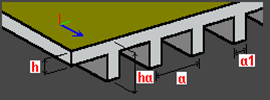
|
One-sided unidirectional ribs: h - plate thickness ha - rib height a - rib spacing a1 - rib width |
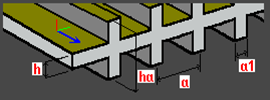
|
Double-sided unidirectional ribs: h - plate thickness ha - rib height a - rib spacing a1 - rib width |
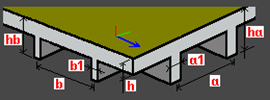
|
One-sided bi-directional ribs: h - plate thickness ha - rib height hb - rib height a - rib spacing a1 - rib width b - rib spacing b1 - rib width |
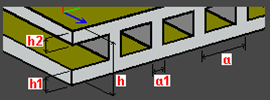
|
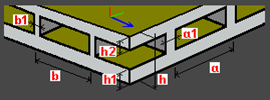
Unidirectional box floor: h - floor thickness h1 - lower plate thickness h2 - upper plate thickness a - rib spacing a1 - rib width |
|
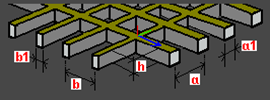
Bidirectional box floor: h - floor thickness h1 - lower plate thickness h2 - upper plate thickness a - rib spacing a1 - rib width b - rib spacing b1 - rib width |
|
Grillage: h - rib height a - rib spacing a1 - rib width b - rib spacing b1 - rib width |
|
Slab on trapezoidal plate: h - plate thickness h1 - steel plate height a - steel plate rib spacing a1 - bottom rib width a2 - top rib width |
|
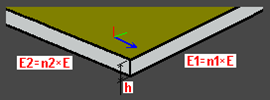
Material orthotropy: h - plate thickness n1 - stiffness coefficient n2 - stiffness coefficient |
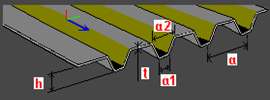
|
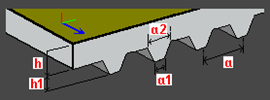
Trapezoidal plate: h - plate height t - plate thickness a, a1, a2 - dimensions of a single plate segment (spacing, width values) |
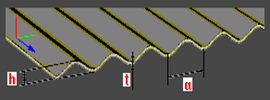
|
Corrugated plate: h - plate height t - plate thickness a - dimension of a single plate segment (spacing) |
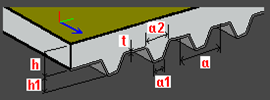
|
Slab composed with a trapezoidal plate h - slab thickness h1 - plate height t - plate thickness a, a1, a2 - dimensions of a single plate segment (spacing, widths) Es - Young's modulus (trapezoid steel) vs - Poisson's ratio (trapezoid steel) Eb - Young's modulus (concrete; an adopted value is based on a selected material) vb - Posson's ratio (concrete; an adopted value is based on a selected material) |
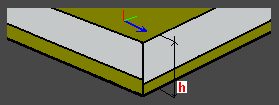
|
Constant thickness with reduced stiffness: h - slab thickness coefficients of reduction of the matrix elements: membrane stiffness D, flexure stiffness K, and shear stiffness H; you can specify a coefficient of weight reduction used when creating self-weight load. You specify these coefficients in the Coefficients of Stiffness, Weight, Mass dialog. |
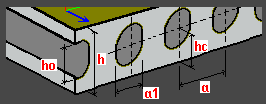
|
Hollow slab (with circular or oval openings) h - slab thickness a - stiffener spacing, opening spacing a1 - opening width / circle diameter ho - opening height (slab with oval openings) hc - distance between the opening center and the slab edge h1 - lower flange height of the slab h2 - upper flange height of the slab (h2 = h - hc - c/2 - a1/2) c = ho - a1 (slab with oval openings) The Disregard transversal bending stiffness check box:
|