UDMGINI3 allows you to define the onset of damage initiation in a plain weave composite.
Damage initiation can be defined at the constituent level (fiber and matrix of each tow) or at the composite level. This routine is called at every equilibrium iteration for every integration point of the plain weave composite material for which you requested a user damage initiation routine. Here is a template for the interface to UDMGINI3.
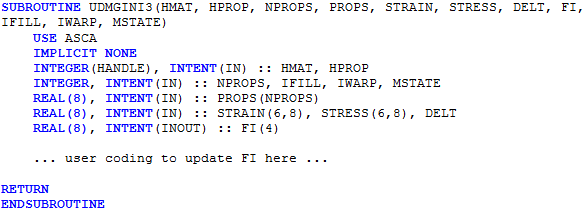
Variables Provided for Information
- HMAT
-
A handle to the current material. This is passed to informational routines (Informational Routines) to access information about the material.
- HPROP
-
A handle to the current material properties. This is passed to informational routines (Informational Routines) to access information about the material properties.
- NPROPS
-
The number of user properties requested. See User Properties.
- PROPS
- User properties. See User Properties.
- STRAIN
-
The current total strain (mechanical and thermal) of the composite, matrix, and fiber. The first column (STRAIN(:,1)) contains the composite strain. Strains are ordered as such: ε11, ε22, ε33, γ12, γ13, γ23. Columns 2-8 contain the strains for the following constituents:
2. Fill tow
3. Warp tow
4. Matrix pocket
5. Fiber in the fill tow
6. Matrix in the fill tow
7. Fiber in the warp tow
8. Matrix in the warp tow
Strains are oriented in the local coordinate system of their respective tow (1-axis parallel to the length of the tow, 2-axis transverse to the tow and in-plane of the weave). The matrix pocket strains are oriented in the local coordinate system of the fill tow. The fiber direction specified in the material definition does not affect the orientation of the strains (and stresses).
- STRESS
-
The current total stress state of the composite, matrix, and fiber. The values of this two-dimensional array are ordered in the same manner as the STRAIN array.
- DELT
- The current overall change in temperature attained thus far in the analysis.
- IFILL
- The current state of failure in the fill tow. A value of one indicates no damage initiation in either constituent. A value of two indicates the matrix has initiated damage.
- IWARP
- The current state of failure in the warp tow. A value of one indicates no damage initiation in either constituent. A value of two indicates the matrix has initiated damage.
- MSTATE
- The current overall state of the material. This encompasses all forms of nonlinearity present in the current material model. This value should only be used to pass to informational routines to obtain more information about the material such as the current material properties.
Variables Updated by the User
- FI
-
Failure indices. The first value (FI(1)) is the failure index of the matrix in the fill tow, and the second value is the failure index of the fiber in the fill tow. The third and fourth values represent the failure index in the fiber and matrix of the warp tow respectively.
If any value equals or exceeds one, that constituent is determined to have initiated damage and will be degraded appropriately. If either fiber is still intact, this subroutine will still be called to predict damage initiation in the other constituents. Once both fiber constituents have failed, this subroutine will no longer be called.