Characterizing Horses
Horses are odd-toed ungulates, as are tapirs, zebras, onagers, kiangs, and rhinoceri.
This page gives some suggestions for how to characterize a horse or other similar skeleton for use with HumanIK. Note that there are many possible ways to characterize a horse; the suggestions below may or may not be appropriate for use with your own characters.
Quadrupeds example
To see a working demonstration of the suggestions on this page, run the Quadrupeds example included with the HumanIK SDK. The HIKSamples.sln solution in <HumanIK_installation_folder>/solutions/<platform_and_toolset> integrates the projects and source code for the samples. For details, see HumanIK Samples.
See also the Quadrupeds.fbx file in <HumanIK_installation_folder>/data/molecule/scenes.
Neutral stance
The neutral stance for your character must meet all the requirements for the quadruped neutral stance that are outlined on the Using HumanIK for Quadrupeds page.
Hind legs
Bone mappings
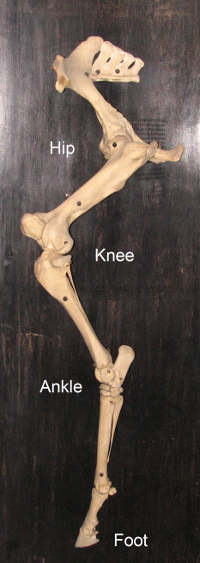
When mapping the horse's hind legs to HumanIK Nodes, it is important not to confuse the knee with the talus (ankle bone).
- The knee of a horse is located very high up on its leg, at the same height as its ribcage.
- The talus is also located high above the ground, and although it is often incorrectly referred to as a knee, it should be mapped to the LeftAnkleNodeId and RightAnkleNodeId.
- The last joint in the chain, which controls the orientation of the sole of the hoof, should be mapped to the LeftFootNodeId and RightFootNodeId.
- Any joints in the skeleton that lie between the joints described above should not be mapped to Nodes.
Other recommendations
To improve the general feel of the poses generated by the IK solver for the hind legs, it is typically best to prevent the hind legs from opening to their full extension during an IK solve. To do this, you can reduce the maximum extension of the leg in the character's HIKPropertySetState to a lower value. A good value for a horse is typically about 150 degrees.
HIKSetPropertyValue(props, HIKLeftLegMaxExtensionAngle, 150.0f);
HIKSetPropertyValue(props, HIKRightLegMaxExtensionAngle, 150.0f);
Forelegs
Bone mappings
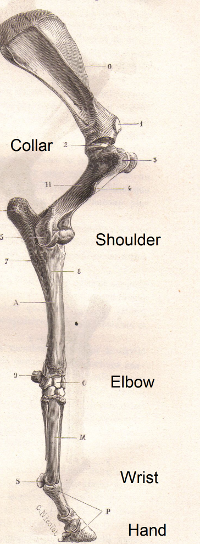
In real life, the horse's elbows should not be confused with its carpal bones (wrists). However, for the purposes of your HumanIK characterization, you will likely find that the IK solver will produce better poses for your character if you intentionally map the carpal bones to the wrist Nodes.
The following mapping strategy is generally recommended for horses:
- The uppermost bones in the skeleton's joint chain should be mapped to the LeftCollarNodeId and RightCollarNodeId.
- The real elbows of the horse skeleton should be mapped to the LeftShoulderNodeId and RightShoulderNodeId.
- The carpal bones should be mapped to the LeftElbowNodeId and RightElbowNodeId. These joints must be inverted, so that they bend in the proper direction:
HIKInverseJoint(character, HIKLeftElbow, 1);
HIKInverseJoint(character, HIKRightElbow, 1);
- The last joint in the chain, which controls the orientation of the sole of the hoof, should be mapped to the LeftFootNodeId and RightFootNodeId.
- The joint immediately before this last joint should be mapped to the LeftAnkleNodeId and RightAnkleNodeId.
- Any other joints in the chain should not be mapped to any Nodes.
This characterization ensures the best possible flexibility for the forelimbs.
 Except where otherwise noted, this work is licensed under a Creative Commons Attribution-NonCommercial-ShareAlike 3.0 Unported License. Please see the Autodesk Creative Commons FAQ for more information.