Gaussian Splat (3DGS) support
New 3D Gaussian Splat (3DGS) support in 3ds Max 2027.2 provides fast rendering, simple editing, and hyper-accurate output.
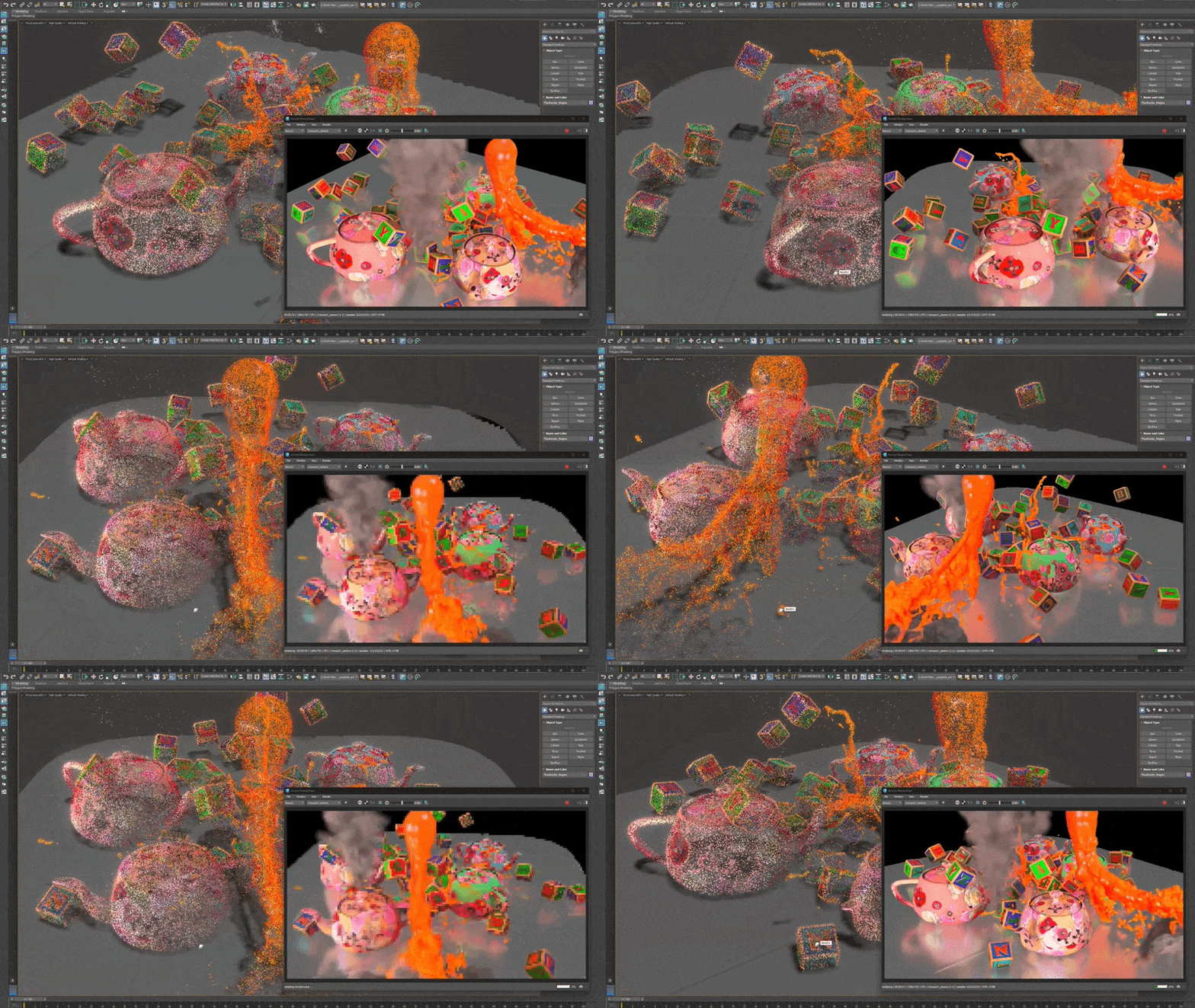
3D Gaussian Splat (3DGS) is a lightweight data format that is used in many industries to generate hyper-realistic 3D environments from real-world data. New support for this popular data format gives a diverse group of 3ds Max users, including those in VFX, Arch Viz, Advertising, and Marketing, access to fast rendering, simple editing, and hyper-accurate output.
The Gaussian Splat shape uses point-based scene representations composed of millions of oriented volumetric splats instead of traditional polygonal geometry. Gaussian splats are often generated from photogrammetry, neural rendering, or radiance field reconstruction workflows and provide an efficient way to represent highly detailed real-world captures. Each splat is represented as an anisotropic 3D Gaussian distribution defined by:
- Position: Center of the splat in 3D space
- Scale: Ellipsoid size along each axis
- Orientation: Rotation of the ellipsoid
- Color/Radiance: Emitted or reflected appearance
- Opacity: Transparency contribution
New 3DGS support lets you seamlessly load 3DGS data, edit the data with familiar tools, and visualize output using supported renderers like Arnold.
3DGS data can be loaded in 3ds Max as an environment or a representation of individual objects. This flexible format can be adopted in any workflow, letting you work in a mixed environment of polygons, splines, and 3DGS data. To get started, simply import a PLY, SPZ, or LCC 3DGS file.
Related documentation
For more information on getting started with 3DGS in 3ds Max, see the following:
For more information on editing and rendering 3DGS data, see the following: