3D Offset Roughing milling strategy
The 3D Offset Roughing toolpath (previously known as Pocket Clearing) cuts in Z levels and the path is determined by offsetting the cut boundary.
It's possible to specify Climb or Conventional cuts, but in some instances Offset Roughing may produced cuts in both directions. Transitional moves are smoothed using the Smoothing Deviation parameter, to limit the tool load in corners. This toolpath can also be effective in 2D prismatic models.
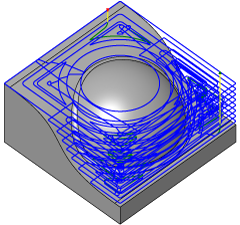
Pocket toolpath on a 3D model.
3D Offset Roughing maintains a constant step over distance. The Stepover is calculated automatically, but you may also specify a Manual Stepover amount. Controls exist for containing the toolpath to a specific area, but as a default, it will assume you want to machine the entire model.
There are 2 methods for creating roughing toolpaths. Adaptive Roughing and Offset Roughing. The Offset Roughing style takes equal XY step overs and creates climb & conventional toolpath motion. The Adaptive Roughing style varies the step over and only takes climb cuts.