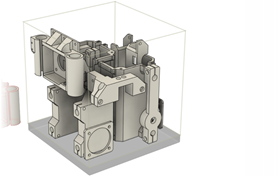
Arrangement for additive manufacturing
The Arrange  tool automatically arranges multiple components so that they fit inside an additive machine's build volume. Choose to arrange in 2D or 3D. Adjust the spacing options to refine the arrangement. If a component cannot be arranged, it is left outside the build volume and is highlighted red on the canvas.
The Sub-Nest Group  tool automatically arranges selected components within a specified volume. This creates a smaller arrangement of components, called a sub-nest, which you can then incorporate into a larger arrangement using Arrange. Sub-nesting requires a manufacturing model. Unlike Arrange, sub-nesting does not use the additive machine's build volume. Instead, components are arranged within a volume that you define, either automatically as the smallest volume possible or manually by specifying width, depth, and height. All selected components, including any copies you specify, must fit within the defined volume. If even one component does not fit, Fusion displays an error and the sub-nest is not created.
You can create multiple sub-nests in a setup, and each sub-nest is grouped into a single component. When you use Arrange, sub-nest components are treated as single items rather than their individual child components. Use sub-nesting to pack a set of components tightly together before placing them in the additive machine's build volume, or use an existing sub-nest as input to another sub-nest to create nested arrangements.
Arrangement types
For Arrange, choose one of the following arrangement types:
2D Arrange (True Shape) places components on a single layer on the build platform, making it ideal for when a single-layer arrangement is sufficient.
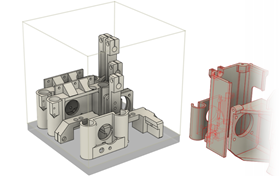
3D Arrange (True Shape) arranges components based on their true shapes, allowing for higher packing density and efficient use of the printer's build volume. It provides options for setting global quantities and rotation, making it ideal for maximizing space utilization and improving packing efficiency.