Blend milling strategy
The Blend strategy performs finishing operations on steep or shallow areas between selected contours. It maintains a consistent cutting direction.
Using this strategy, you can machine complex geometry achieving surface finish of high quality. You can also detect and machine undercuts.
Geometry
The Blend strategy requires surfaces to guide creation of the toolpath. They are called Drive Surfaces. If you want to confine the toolpath to a smaller area within the drive surfaces, specify the Machining Boundary.
Drive curves
The strategy requires a start and an end drive curve to control the toolpath. You can also add intermediate drive curves between them.
Intermediate curves are surface edges within the machined region. They smooth the toolpath when the start and end curves are quite different, and can improve surface finish on complex geometry. The start curve must be first in the list and the end curve last; the order of intermediate curves between them does not matter.
Which curve you set as start and which as end (on the same section of geometry) affects how the strategy creates the toolpath.
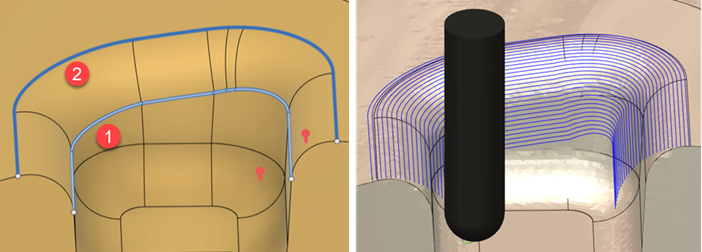
The bottom curve is selected first. The Blend toolpath starts at the bottom curve.
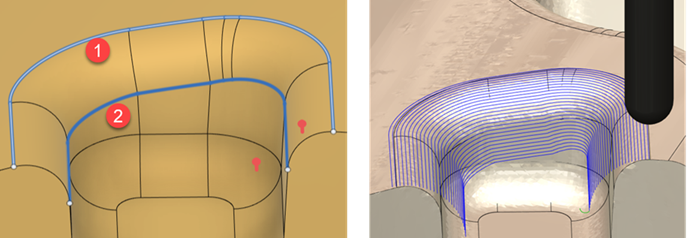
The top curve is selected first. The toolpath starts at the top curve.
Machining undercuts
You can detect and machine undercuts with a 3-axis toolpath after you:
Select suitable tools like lollipop mill, dovetail mill, or slot tool.
On the Passes tab, from the Stepover Calculation drop-down, select the On surface option. It calculates the stepover based on the surface of the part.