
Understanding the Wiretap Gateway Server Node Hierarchy
Similarly to the IFFFS Wiretap Server, the Wiretap Gateway uses a hierarchy of nodes to expose the structure of a public file system, intelligently presenting supported media as clips.
The Gateway server is a multi-process system that consists of two process types:
The main process, launched at startup, dispatches calls to the other processes.
The session processes are created upon connection from a client and maintain a consistent and isolated state for each client. They are tied to the client process, and all server handles created by a client process will use the same session.
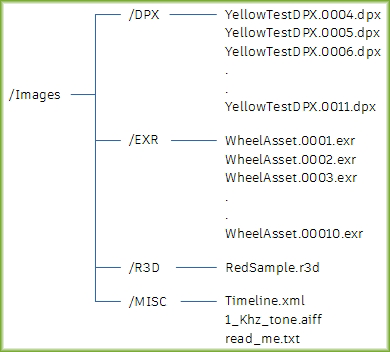
The Wiretap Gateway exposes the directories, clips and files of a file system. The following diagram shows a directory structure containing DPX, OpenEXR and RED raw image files, plus audio and a timeline in XML format.
The following diagram shows the same directories as seen through the Wiretap Gateway.
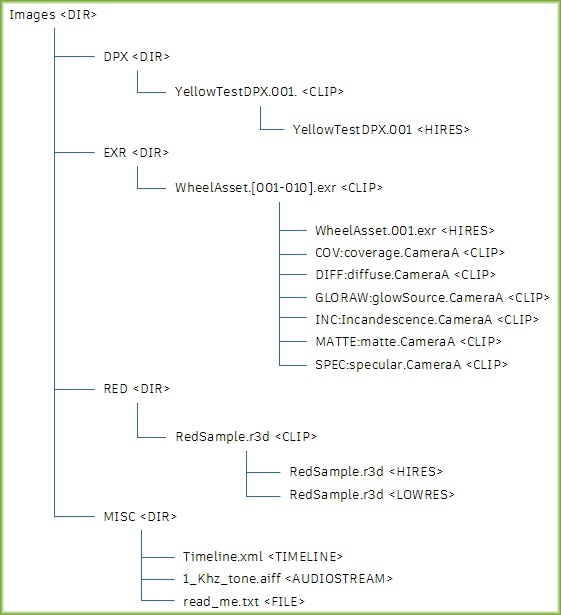
The following table presents the node types exposed through the Wiretap Gateway.
| Node Type | Description |
|---|---|
| NODE | Generic node type. Used mainly to contain directory (DIR) nodes. |
| DIR | DIR nodes are the first level below the root node of the server. |
| CLIP | A CLIP node exposes media in the form of frames. For details, see Structure of a Wiretap Gateway Server Clip Node. |
| HIRES | A HIRES node contains high-resolution video frames. |
| LOWRES | A LOWRES node contains low-resolution video frames. Note: Only selected CLIP nodes have low-resolution representations. For example, RED (.r3d) CLIP nodes. |
| AUDIOSTREAM | An AUDIOSTREAM node represents a block of audio media. |