Evaluate perceived temperature on site by combining sun hours, daylight potential, and wind exposure with localized weather and climate data.
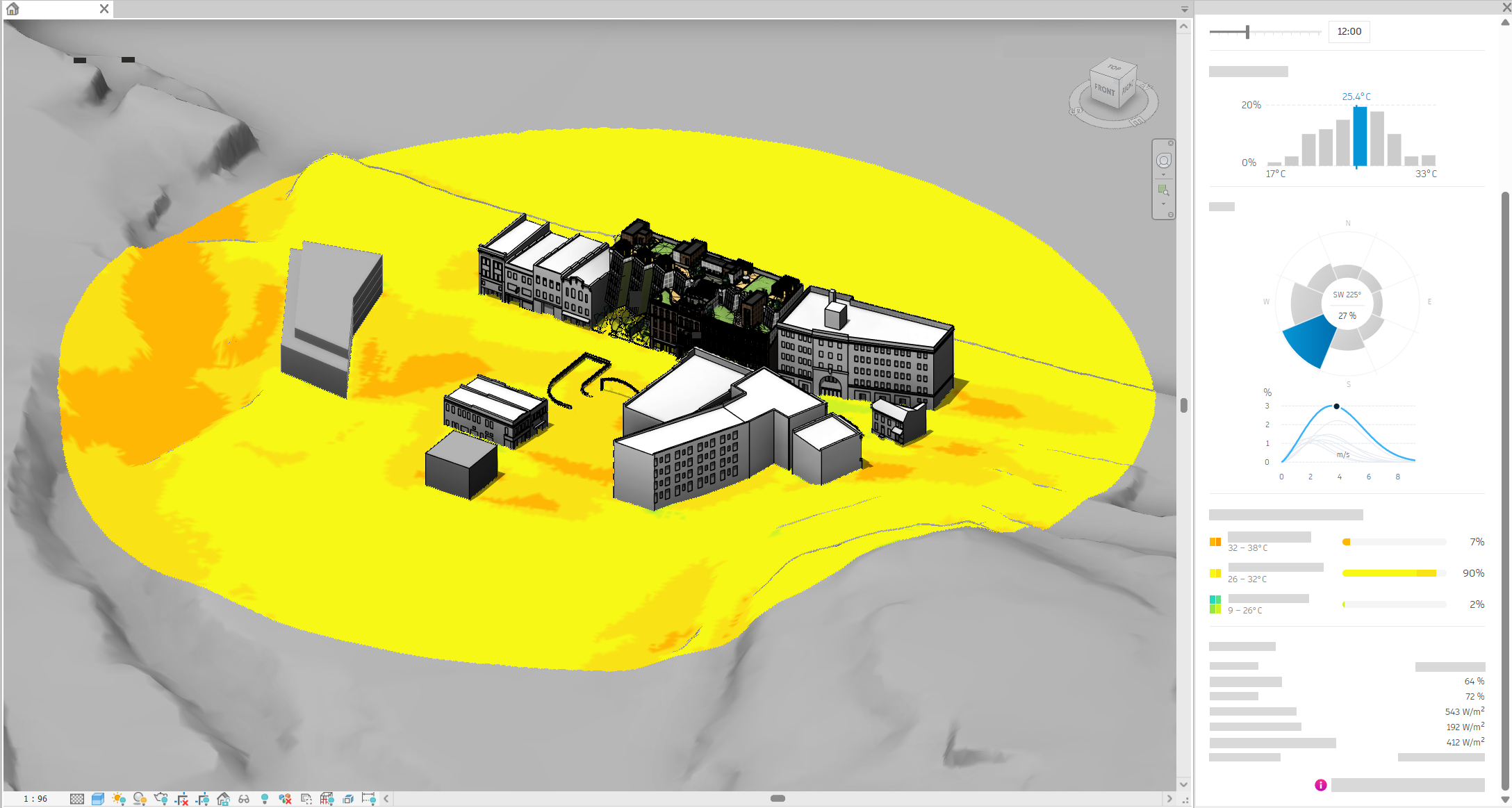
What the analysis evaluates
Use microclimate analysis to understand how your design may affect local outdoor climate conditions. These insights can help you make more informed decisions when designing outdoor spaces for occupant comfort and sustainability.
The analysis considers all modeled site elements, including terrain, building models, surrounding buildings, and other context. It can be run on a circular study area with a radius between 150 and 500 meters (492–1,640 feet). The analysis typically completes in about 4-10 seconds, providing information on perceived temperature within the study area.
Perceived temperature represents how outdoor conditions feel to people rather than the measured air temperature alone. For example, an air temperature of 20°C may feel closer to 15°C because of factors such as wind, humidity, solar radiation, and shading.
How the analysis works
Forma microclimate analysis uses the Universal Thermal Climate Index (UTCI) to calculate perceived temperature. UTCI is a widely adopted standard for evaluating outdoor thermal comfort by combining multiple environmental factors into a single "feels like" temperature.
To generate results, the analysis combines the following:
- Direct solar radiation from the Sun analysis
- Indirect solar radiation based on visible sky fraction
- Local wind speeds from the Wind Estimate analysis
- Weather data such as air temperature, humidity, cloud coverage, and solar radiation
The analysis uses historical weather data from 2013–2020 to establish statistically representative conditions for the selected date and time. Weather information is sourced from the ERA5 data set provided by the Copernicus Climate Change Service. Wind roses are obtained from the Global Wind Atlas. The UTCI calculations have been verified against industry-standard tools and reviewed with external consultants to help ensure results are consistent with established industry practices.
Evaluate different weather scenarios
After selecting a month and time of day, you can explore how changing weather conditions affect perceived temperature. Historical meteorological data provides typical values for the selected time, while controls let you adjust the dry bulb (air) temperature to investigate less common or more extreme conditions.
You can also select the incoming wind conditions used in the calculation. Other meteorological inputs required for the UTCI calculation are automatically determined from historical statistical data and displayed in the Weather Data information panel.
Current limitations
Microclimate analysis does not currently account for the following:
- Thermal effects of ground and surface materials, such as albedo or evapotranspiration.
- The presence of vegetation, including plants and trees modeled using Revit families.
See assumptions related to sun hours, daylight potential, and wind estimate calculations.