Multiple transform is an easier method of performing multiple Moves or Rotations on a selection of curves.
To display the Multiple transform dialog, click:
- Curve Editor tab > Edit panel > Transformations > Multiple Transform.
- Toolpath Transform tab > Transform panel > Multiple Transform.
- Pattern Transform tab > Transform panel > Multiple Transform.
- Boundary Transform tab > Transform panel > Multiple Transform.
- Workplane Transform tab > Transform panel > Multiple.
- Edit > Transform on the individual toolpath, boundary, pattern, or workplane context menus.
The orientation of the transform is determined by the principal working plane
 ,
,
 , or
, or
 , set in the
Information toolbar.
, set in the
Information toolbar.
The Rectangular tab contains the following:
-
 Number of rows —Enter a value or use
 to specify the number of columns.
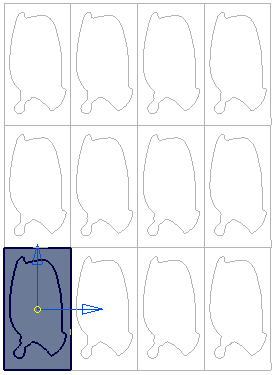
This curve transform has 3 rows and 4 columns:
-
 Distance between rows —Enter the distance between one instance and the next.
 -
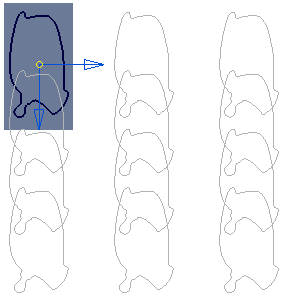
 Rotate axis — Click to rotate the transform by 90
 in a clockwise direction in the principal working plane.
Converts this:
to this:
-
 Workplane origin — When selected, the active workplane is the origin. If no workplane is active then the global coordinate system is the origin.
 -
 Bounding box origin — When selected, the origin is the centre of the bounding box containing all the entities.
 -
 Move origin — When selected, you can move the origin graphically by dragging or by entering coordinates using
  ,
,  , or
, or  and
and  in the Status bar.
 -
 Distance between columns — Enter the distance between one instance and the next.
 -
 Number of columns — Enter a value or use to specify the number of columns.
This curve transform has 3 rows and 4 columns:
-
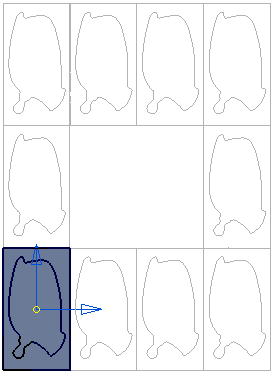
Hollow box — This places the duplicated curves around the perimeter of the transform and removes the central ones.
Converts this:
to this:
For information on the Circular tab, see Multiple transform — Circular.
For more information, see Rectangular transform example; this example shows you how to create multiple moves on a toolpath using a rectangular pattern, but the principle is the same for curves.